

For many young women, the decision to pursue science, technology, engineering or mathematics begins long before they apply to university or choose a career.
It can begin in a classroom.
A teacher makes mathematics feel possible. A mentor encourages a learner to ask another question. A woman working in science becomes proof that the career is achievable. Or a young girl is given the confidence to enter a space she may previously have believed was not meant for her.
These were some of the powerful themes explored during the Regenesys School of Education masterclass, Celebrating Women Leadership in Commerce and STEM. The conversation brought together women educators who reflected on their journeys through mathematics, science, commerce and teacher education, while examining what still needs to change for the next generation of women in STEM.
Watch the full masterclass:
The discussion also raised a bigger question: if representation matters, who will educate, encourage and prepare the girls who could become tomorrow’s scientists, mathematicians, entrepreneurs and technology leaders?
For aspiring educators who want to become part of that journey, explore the Regenesys Bachelor of Education in Senior Phase and Further Education and Training Teaching.
TABLE OF CONTENTS
Why Women in STEM Representation Matters
Representation can influence what people believe is possible.
When young girls repeatedly see men presented as scientists, engineers, mathematicians or technology experts while women appear far less often, STEM can begin to look like a space in which they are visitors rather than participants.
The masterclass challenged that perception.
One panellist reflected on becoming the only woman in a mathematics department. Others described teachers who had inspired their own interest in mathematics and science by making difficult concepts engaging, understandable and relevant.
Those experiences highlight why visible women in STEM matter.
Representation is not simply about celebrating successful women after they have reached senior positions. It is also about allowing a learner in a classroom, township, rural community or under-resourced school to look at another woman and think:
“If she can do this, perhaps I can too.”
This challenge extends beyond South Africa. UNESCO’s work on girls and women in STEM education highlights the importance of tackling barriers that influence girls’ participation in STEM education and careers.
What Barriers Still Affect Women in STEM?
Celebrating progress should not prevent us from examining the obstacles that remain.
The Regenesys masterclass identified several interconnected barriers that may affect girls and women entering STEM-related fields:
- Gender stereotypes about who is naturally suited to mathematics and science
- Male-dominated academic and professional environments
- Limited representation of women in some STEM spaces
- Fear of making mistakes or appearing incapable
- Language and academic-access challenges
- Limited mentorship and encouragement
- Cultural expectations around gender roles
- Mathematics and science being presented as intimidating or disconnected from everyday life
These barriers matter because learners do not choose subjects and careers in isolation.
The messages they receive from teachers, families, communities, peers and society can influence how they perceive their own abilities.
A girl may have the ability to excel in mathematics but still decide that mathematics is “not for her” if that belief is reinforced often enough.
Removing barriers therefore requires more than telling girls that STEM careers are available. It requires changing how girls experience STEM from the beginning.
Why Girls in STEM Need Teachers and Role Models
One of the clearest themes from the masterclass was the influence teachers can have on a learner’s future.
Several speakers could trace important moments in their careers back to educators who changed how they experienced a subject.
A passionate mathematics teacher made geometry enjoyable.
A science teacher transformed abstract concepts into something understandable.
Those experiences later contributed to careers in teaching, higher education, mathematics, science and commerce.
This demonstrates why encouraging girls in STEM cannot begin only when they reach university.
It needs to begin much earlier.
When teachers make difficult concepts understandable, encourage questions and demonstrate enthusiasm for their disciplines, they can influence whether learners move towards or away from those subjects.
UNICEF’s work on girls’ education through STEM also explores how STEM education can help expand opportunities for girls and strengthen their participation in science and technology.
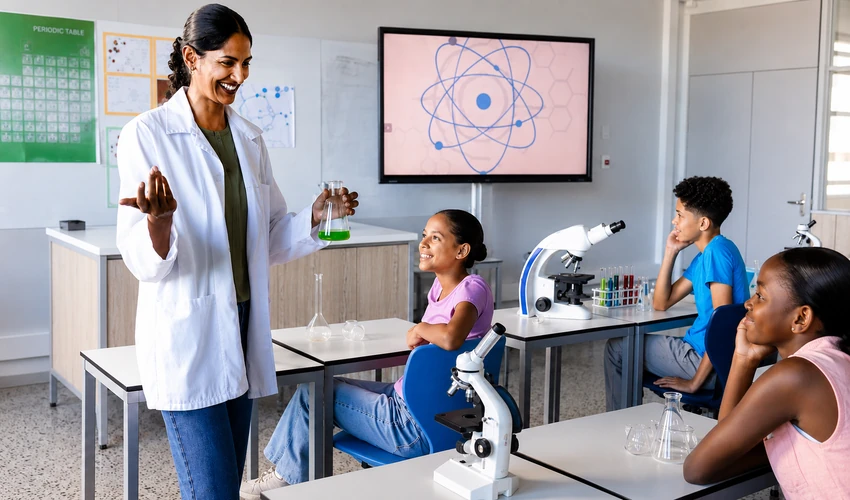
STEM Education Is Also About Access
A learner struggling with science does not necessarily lack scientific ability.
Sometimes the real problem is access.
The masterclass explored the language of mathematics and science and how learners who struggle with foundational language or numeracy may later experience difficulty accessing more abstract concepts.
Mathematics introduces specialised terminology, symbols and reasoning.
Science also has its own vocabulary, structures and ways of explaining the world.
If those concepts are presented without considering how learners understand language and prior knowledge, the subject can appear far more difficult than it needs to be.
Strong STEM education therefore requires more than expertise in the subject.
Teachers also need to know how to make knowledge accessible.
Why Making STEM Relevant Can Change the Way Learners See It
Mathematics is not confined to a textbook.
It appears in budgeting, cooking, economics, construction, technical drawing, statistics, business and everyday decision-making.
Science is similarly connected to problems people experience every day.
One of the masterclass panellists emphasised the importance of helping learners connect abstract knowledge to experiences they already understand.
Instead of beginning with concepts that feel completely unfamiliar, educators can build from real-life experiences before moving towards abstraction.
That matters because relevance can change a learner’s relationship with a subject.
The question moves from:
“Why do I need to learn this?”
to:
“Where else can I use this?”
Women in Leadership Are Building More Than Careers
The masterclass also broadened the definition of women in leadership.
Leadership is not limited to holding an executive title.
There are women building businesses, leading classrooms, conducting research, teaching children how to budget, mentoring future teachers and creating opportunities for people who may follow them.
These women are building pipelines.
A teacher encouraging one girl to stay with mathematics may indirectly influence a future engineering career.
A commerce educator may inspire a learner who later builds a business.
A mother teaching financial responsibility at home may be developing entrepreneurial thinking years before her child encounters the concept formally.
This makes leadership generational.
The impact of one woman does not necessarily end with her own achievement. It can continue through the people she teaches, mentors and inspires.
Women in STEM South Africa: Why the Classroom Matters
The conversation is particularly significant when considering women in STEM South Africa.
South Africa needs young people who can solve increasingly complex scientific, technological, educational and economic challenges.
But the pipeline into those careers begins with education.
A learner who disengages from mathematics or science at school may remove several later study and career possibilities before she fully understands what those possibilities are.
This is why teachers occupy such an influential position.
They are not simply delivering content.
They can help learners develop confidence, curiosity, resilience and the belief that difficult subjects can be mastered.
For girls who may already be confronting stereotypes about STEM, that encouragement can be especially important.
How Can Teachers Encourage More Girls to Pursue STEM?
1. Make Curiosity More Important Than Perfection
STEM should not be positioned as a space reserved only for learners who always receive the highest marks.
A willingness to learn, investigate and keep asking questions matters.
One of the strongest messages from the masterclass was that learners should not confuse being unfamiliar with something with being incapable of doing it.
2. Make It Safe to Make Mistakes
Learners who become afraid of being wrong may eventually stop participating.
Strong teachers help learners understand that mistakes are part of solving problems and developing knowledge.
3. Give Learners Someone to Ask
Mentorship matters.
Learners need teachers, facilitators and role models they feel comfortable approaching when they do not understand something.
One unanswered question should not become the reason a learner abandons a subject.
4. Challenge Stereotypes Directly
Teachers should not assume that learners will automatically ignore the stereotypes they encounter elsewhere.
Classrooms can actively communicate that mathematics, science, technology and commerce are not defined by gender.
5. Show Where STEM Can Lead
STEM is ultimately about solving problems.
It can lead learners towards opportunities in technology, science, mathematics, research, education, entrepreneurship and numerous emerging industries.
Helping learners understand those possibilities can make their current studies feel more purposeful.
What Does a Future-Ready STEM Teacher Need?
Knowing mathematics is not the same as knowing how to teach mathematics.
Understanding science does not automatically mean knowing how to make science understandable to a diverse classroom.
A future-ready STEM teacher needs both content knowledge and pedagogical knowledge.
That can include the ability to:
- Explain complex ideas clearly
- Connect learning to real-world contexts
- Respond to different learner needs
- Use technology meaningfully
- Develop digital and AI literacy
- Create inclusive classrooms
- Reflect on teaching practice
- Build learner confidence
- Manage classrooms effectively
- Continue developing professionally
The future of education will demand teachers who are adaptable rather than static.
Technology will change.
Artificial intelligence will continue influencing education.
Classrooms will remain diverse.
Future educators therefore need to be prepared not only for today’s classroom but also for the classroom that is still emerging.
How Regenesys Prepares Future Teachers
The masterclass provided valuable insight into the philosophy behind teacher preparation at Regenesys.
The emphasis is not simply on traditional lecturing.
Students enter learning environments with lived experiences and existing knowledge. Those experiences can become part of the learning process rather than something that is ignored.
Reflection also plays an important role.
Prospective teachers are encouraged to examine their experiences, understand how learners encounter different subjects and develop the ability to adapt their teaching.
The discussion also highlighted technology, artificial intelligence, mentorship, practical learning and holistic development as part of preparing future educators.
Those interested in learning more about this approach can explore the Regenesys School of Education.
Could You Become the Teacher Who Opens the Door?
Behind many successful people is an educator who helped them believe something was possible.
A woman may eventually become a scientist because a teacher made science understandable.
Another may become an entrepreneur because a commerce teacher helped her understand how businesses work.
A future mathematician may simply have needed someone to tell her that one difficult equation did not determine her ability.
This is what makes teaching such a powerful part of the women-in-STEM conversation.
It is not only about asking:
“How do we get more women into STEM?”
We should also ask:
“Who will inspire them to enter in the first place?”
If you want to become one of those educators, explore the Regenesys Bachelor of Education and discover how you can begin building an impactful teaching career.
Breaking Barriers Is Only the Beginning
Celebrating women who succeed in STEM and commerce is important.
But celebration alone cannot be the destination.
The bigger objective is to make the journey easier for the women coming next.
That requires teachers who challenge stereotypes.
It requires mentors who make time for questions.
It requires visible women in leadership.
It requires families and communities that encourage girls to explore.
And it requires education that makes mathematics, science, technology and commerce feel accessible rather than exclusive.
The closing message of the masterclass captured this powerfully: women’s leadership in STEM and commerce should not only be about breaking barriers. It should also be about building doors for those coming behind us.
The next generation of scientists, mathematicians, economists, entrepreneurs and teachers may already be sitting in classrooms today.
The question is whether we are creating the conditions that allow them to see what they could become.
Frequently Asked Questions About Women in STEM and Education
Why are women important in STEM?
Women strengthen STEM by bringing additional perspectives, experiences and ideas into scientific and technological problem-solving. Greater representation can also give girls visible role models and expand what younger learners believe is possible.
Why are women still underrepresented in STEM?
Women may encounter barriers including gender stereotypes, social expectations, unequal access to opportunities, limited mentorship and perceptions that mathematics and science are male-dominated fields.
Why is STEM education important for girls?
STEM education develops problem-solving, analytical, digital and technical capabilities that can support pathways into science, technology, mathematics, entrepreneurship and emerging careers.
How can teachers encourage girls to pursue STEM?
Teachers can challenge stereotypes, make subjects relevant, provide mentorship, celebrate curiosity, allow learners to make mistakes and expose them to women succeeding in STEM careers.
Why do female STEM role models matter?
Female STEM role models show girls that women can succeed in mathematics, science and technology. Representation can challenge limiting assumptions and make STEM careers feel more achievable.
What skills does a STEM teacher need?
A STEM teacher needs strong subject knowledge, pedagogical skills, communication, adaptability, classroom management and the ability to make complex concepts relevant and accessible.
How can I become a STEM teacher in South Africa?
A common pathway is completing an accredited professional teaching qualification such as a Bachelor of Education with suitable subject specialisations for the school phase and subjects you want to teach.
Can teachers help reduce the gender gap in STEM?
Yes. Teachers can influence confidence, subject selection and career aspirations by creating inclusive classrooms, challenging stereotypes and encouraging girls to remain engaged with mathematics and science.
What role does leadership play in supporting women in STEM?
Leadership can create environments where women have access to opportunities, mentorship, recognition and career development. Women leaders can also open pathways for those coming after them.
How can South Africa build the next generation of women in STEM?
South Africa can strengthen the pipeline through stronger STEM education, capable teachers, mentorship, gender-inclusive classrooms, visible female role models and opportunities that help girls progress from school into higher education and STEM careers.