

Artificial intelligence sounds like a future career, but the salary question is already very real. If you are thinking about becoming an AI engineer in South Africa, you probably want a straight answer: how much can you actually earn? Not the global hype. Not Silicon Valley numbers. Not a random figure pulled from a job post. You want to know what the South African market looks like, what entry-level professionals can expect, what experienced AI engineers earn and what skills push salaries higher.
The short answer is that AI engineers in South Africa can earn anything from around R350,000 to more than R1.3 million per year, depending on experience, technical depth, industry, location and whether the role is truly AI engineering or a broader software, data or automation role.
The more useful answer is that salary depends on what kind of AI work you can do. Someone who only knows how to use AI tools will not earn the same as someone who can build, test, deploy and secure AI-powered systems.
That is why programmes such as the Artificial Intelligence Software Developer programme are becoming relevant for learners who want to move beyond basic AI awareness and build practical software development capability for an AI-driven job market.
What Is the Average AI Engineer Salary in South Africa?
The average AI engineer salary in South Africa varies depending on the source, because “AI engineer” is still a developing job title. Some companies use the title for machine learning specialists. Others use it for software developers who build AI-powered applications. Some roles are closer to data science, while others focus on automation, chatbots, APIs or generative AI systems.
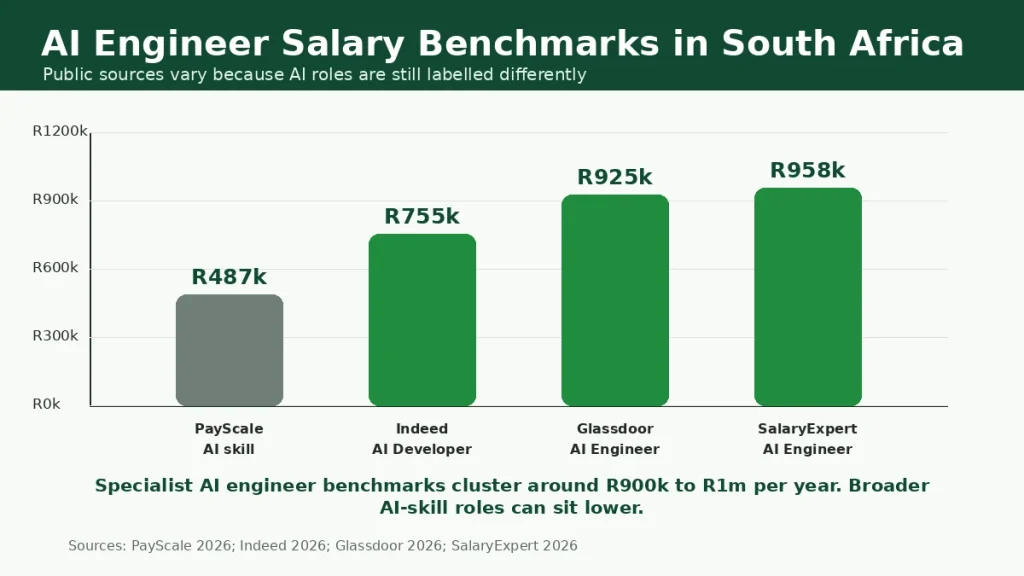
That is why salary data can look inconsistent. According to SalaryExpert, the average artificial intelligence engineer salary in South Africa is about R958,000 per year. The same source estimates entry-level AI engineer pay at around R677,000 per year and senior-level pay at about R1.105 million per year.
Glassdoor lists AI Engineer pay in South Africa at about R925,000 per year, with a typical range between R800,000 and R1.177 million. However, that estimate is based on a small number of submitted salaries, so it should be read as a market signal rather than a complete national benchmark.
Indeed lists the average AI Developer salary in South Africa at about R755,000 per year, while PayScale shows a broader artificial intelligence skill salary average of about R487,000 per year.
Taken together, the market picture is clear: specialist AI engineering roles can move close to R1 million per year, while broader AI-related roles may sit lower, especially where the person is still building experience.
AI Engineer Salary in South Africa by Experience Level
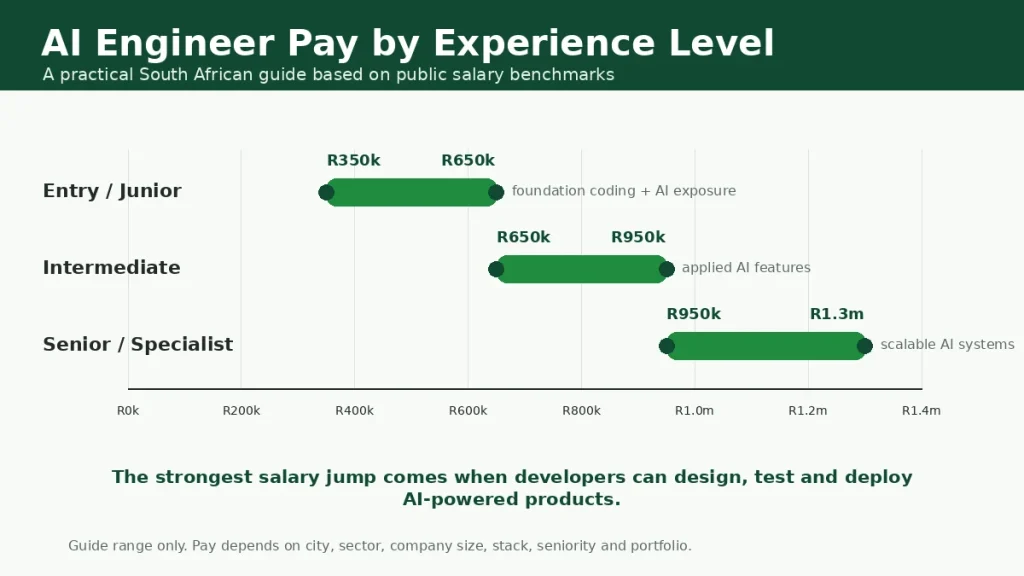
A practical salary guide for AI engineers in South Africa looks like this:
| Experience Level | Estimated Annual Salary | Estimated Monthly Salary |
|---|---|---|
| Entry-level / Junior | R350,000 – R650,000 | R29,000 – R54,000 |
| Intermediate | R650,000 – R950,000 | R54,000 – R79,000 |
| Senior / Specialist | R950,000 – R1.3 million+ | R79,000 – R108,000+ |
These are not fixed salaries. They are realistic market ranges based on public salary data, related AI roles and South African software development salary patterns.
A junior AI engineer may start below the high salary benchmarks if the role is closer to junior software development, Python development, data analysis or AI tool support. This is normal. Most people do not begin by designing production-ready AI systems from day one.
Intermediate AI engineers usually earn more because they can build features, connect systems, work with APIs, test outputs and contribute to real applications.
Senior AI engineers earn the most because they can solve complex problems. They may design AI architecture, manage model deployment, build scalable systems, guide teams, reduce risk and connect AI solutions to business outcomes.
In simple terms: salary rises when responsibility rises.
Why AI Engineer Salary Data Can Be Confusing
AI salary data is confusing because the job market has not fully standardised AI titles yet. One company may advertise an “AI Engineer” role but expect machine learning model development. Another may use the same title for someone building AI-powered web applications. A third may be looking for a full-stack developer who can integrate large language models into business workflows. These roles may sound similar, but they are not paid the same.
There are also related titles that overlap with AI engineering, including:
- Artificial Intelligence Software Developer
- Machine Learning Engineer
- AI Developer
- Data Scientist
- AI Application Developer
- Python Developer
- MLOps Engineer
- AI Solutions Engineer
- Automation Developer
- Full-Stack AI Engineer
This is why learners should not only search for one title. They should understand the skills behind the title. An “AI engineer” who can only use AI tools may earn less than a software developer who can build secure AI applications. A data scientist with strong machine learning skills may earn differently from an AI software developer who focuses on product integration. A senior AI engineer with cloud, deployment and security experience may earn significantly more than someone who only works on prototypes.
The salary is not attached to the word “AI”. It is attached to the value you can deliver with AI.
What Skills Increase an AI Engineer’s Salary?
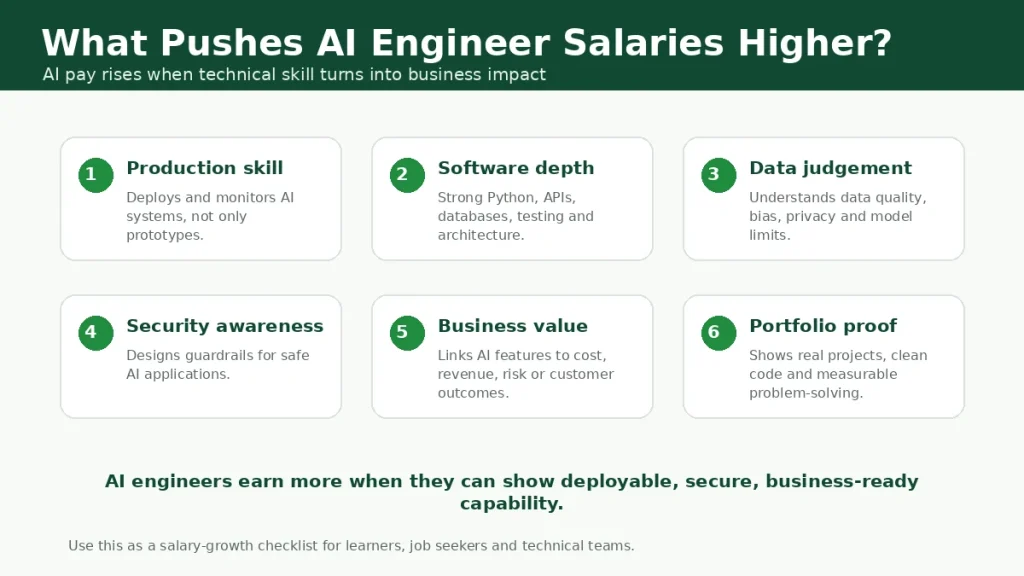
The highest-paying AI roles usually require more than basic AI knowledge. They reward people who can combine software engineering, data, business thinking and responsible implementation.
Programming Skills
Programming is still the foundation. Python is especially useful because it is widely used in machine learning, data science, automation and AI development.
However, AI engineers may also benefit from JavaScript, SQL, APIs, cloud tools and software architecture. The more complete your engineering foundation, the easier it becomes to build real AI products.
Machine Learning and Data Understanding
AI systems depend on data. Engineers who understand data quality, model behaviour, classification, prediction, training data and evaluation are more valuable than those who only know how to call an AI API.
Machine learning knowledge helps AI engineers understand why outputs succeed, fail or drift over time.
AI Application Development
Many businesses do not need someone to build a model from scratch. They need someone who can build an application that uses AI well.
That includes chatbots, recommendation systems, document analysis tools, automation workflows, intelligent dashboards and internal productivity systems.
This is where the Artificial Intelligence Software Developer programme becomes especially relevant, because it focuses on practical AI software development and real-world problem-solving.
Cloud, APIs and Deployment
AI engineers who can deploy systems are more valuable than those who only work locally on small experiments.
Businesses need AI systems that users can access, teams can maintain and companies can trust. That requires knowledge of APIs, cloud platforms, backend systems, databases, testing, monitoring and deployment.
Cybersecurity and Responsible AI
AI systems can create security and privacy risks. They may handle sensitive data, connect to business systems or generate outputs that influence decisions.
Engineers who understand secure coding, access control, data privacy and responsible AI design can command stronger salaries because they reduce risk for employers.
Business Problem-Solving
The best AI engineers do not only ask, “Can we build this?” They ask, “Should we build this, who will use it and what value will it create?” Business thinking matters because AI projects fail when they are technically impressive but commercially useless. Employers value engineers who can connect AI to measurable outcomes such as cost reduction, productivity, revenue, risk control or customer experience.
Which Industries Pay AI Engineers Well in South Africa?
AI engineer salaries in South Africa are usually strongest in industries where data, automation and digital platforms are central to business performance.
These include:
- Financial services
- Banking
- Insurance
- Telecommunications
- Retail and e-commerce
- Logistics
- Health technology
- Education technology
- Cybersecurity
- Consulting
- Software product companies
- Global remote-first technology firms
Financial services and telecommunications often pay well because they rely heavily on data, automation, risk modelling, fraud detection and digital customer platforms.
Software product companies may pay strong salaries when AI is part of the product itself. A company building AI-powered tools needs people who can ship features, not only experiment.
Remote work can also affect earnings. A South African AI engineer working for an international company may earn differently from someone working only in a local market. However, international roles also tend to be more competitive and require stronger portfolios, communication and technical maturity.
How AI Engineer Salaries Compare With Related Tech Roles
AI engineering often overlaps with software development, machine learning, data science and automation. That is why related salary benchmarks matter.
PayScale lists the average salary for a data scientist in South Africa at about R460,000 per year, with higher earners moving closer to R800,000. PayScale’s broader machine learning skill salary data also shows that machine learning-related roles can vary widely depending on title and experience.
This suggests an important career pattern: AI engineering usually becomes more lucrative when it moves from analysis to production.
A person who can analyse data is valuable. A person who can build an AI-powered system from that data is often more valuable. A person who can deploy, monitor and secure that system is even more valuable.
That is why AI engineers with software development depth often have strong earning potential. They are not only interpreting information. They are building tools that people can use.
Are AI Engineers in Demand in South Africa?
Yes, but the demand is more specific than the hype suggests. Businesses are not simply hiring anyone who says they know AI. They are looking for people who can apply AI responsibly, build useful systems and improve productivity.
The OfferZen 2026 Salary and Benefits Report notes that AI fluency and product thinking are becoming baseline expectations for engineers. This is important because it means AI skills are no longer a separate “nice to have” for many technology roles. They are becoming part of what employers expect from modern developers.
Globally, the World Economic Forum Future of Jobs Report 2025 identifies AI and big data as the fastest-growing skills. The US Bureau of Labor Statistics projects strong growth for software developers, quality assurance analysts and testers from 2024 to 2034.
South Africa’s AI market is still developing, but the direction is clear. Companies want to use AI in customer service, data analysis, automation, cybersecurity, marketing, education, finance and operations. The opportunity is there, but it belongs to people with real capability.
How to Earn More as an AI Engineer in South Africa
If your goal is to increase your AI engineer salary in South Africa, focus on building proof. A certificate can help, but employers also want evidence that you can build. Your portfolio, projects and practical skills matter.
Build AI Projects That Solve Real Problems
Do not only build generic demos. Build projects that show business value.
Examples include:
- A chatbot that answers questions from a structured knowledge base
- A document summariser for internal reports
- A lead-scoring tool for sales teams
- An inventory prediction tool
- A customer feedback analysis dashboard
- A fraud-pattern detection prototype
- A study assistant using natural language processing
- An automated reporting tool
The best projects show that you can connect AI to a real use case.
Learn Software Development Properly
AI engineering is not only about models. It is also about software. You need to understand programming, databases, APIs, testing, debugging and deployment. Without these foundations, it becomes difficult to build production-ready applications.
Learners who want to develop these foundations can start with the Artificial Intelligence Software Developer programme or explore broader AI learning through the AI for Developers pathway.
Learn to Work With AI Tools Without Depending on Them
AI tools can help you code faster, but they should not replace your understanding. A strong AI engineer knows how to prompt, review, test and improve AI-generated output. They know when an answer looks right but is technically weak. They understand why code works, not only that it runs. This is the difference between AI tool use and AI engineering capability.
Add Security and Governance to Your Skill Set
Many AI projects fail because teams ignore security, privacy or responsible AI design. If you can show that you understand data protection, access control, testing, hallucination risks, prompt injection and safe deployment, you become more valuable to employers. Businesses want AI innovation, but they also want control.
Keep Learning as the Market Changes
AI engineering changes quickly. Tools evolve, models improve and business needs shift. A learner who stops at one course or one tool will fall behind. A learner who keeps building, reading, testing and improving will have a much better chance of growing into higher-paying roles.
The Digital Regenesys Artificial Intelligence Course can also support learners who want flexible online exposure to AI, automation and data-driven applications.
What Businesses Should Know About AI Engineer Salaries
For businesses, AI salary data should be used carefully. If a company wants someone to experiment with AI tools, the salary may be different from a role that requires production engineering. If the role includes architecture, deployment, cloud infrastructure, MLOps, security and stakeholder management, the pay should reflect that.
Hiring a low-cost AI engineer for a high-risk AI project can become expensive later. Poorly built AI systems can create security issues, unreliable outputs, customer frustration and technical debt.
The better approach is to define the role clearly.
Businesses should ask:
- Will this person build AI applications?
- Will they train or fine-tune models?
- Will they integrate third-party AI APIs?
- Will they work with sensitive data?
- Will they own deployment and monitoring?
- Will they design AI governance and guardrails?
- Will they mentor other developers?
The clearer the role, the more accurate the salary benchmark becomes.
Organisations that want to build AI capability across teams can explore Regenesys Corporate Education, which focuses on helping enterprises develop AI fluency, applied capability and AI-enabled engineering skills.
Is AI Engineering a Good Career in South Africa?
AI engineering can be a strong career path in South Africa, especially for people who enjoy software development, data, problem-solving and continuous learning.
The salary potential is attractive, but it should not be the only reason to enter the field. AI engineering is demanding. It requires technical patience, curiosity and the ability to keep learning.
The strongest candidates will be those who can combine three things:
- Software development skill
- AI and data understanding
- Business problem-solving
This combination is powerful because it helps companies turn AI ideas into usable systems.
A person who understands AI theory may be useful. A person who can build AI software is more useful. A person who can build AI software that is secure, scalable and commercially valuable is the kind of professional who can move into higher salary ranges.
What AI Engineer Salaries Reveal About the Future of Tech Careers in South Africa
The AI engineer salary in South Africa tells a bigger story than money alone. It shows that the market is beginning to reward people who can move beyond basic coding and basic AI tool use. The highest value sits with professionals who can build intelligent systems, connect them to real business problems, test them properly, secure them and improve them over time.
That is why AI engineering is not just a trendy career title. It is part of a wider shift in how software is built and how businesses compete. The future will not belong to people who only know how to ask AI tools for answers. It will belong to people who understand how to build, evaluate and deploy AI-powered solutions responsibly.
For learners who want to prepare for that future, the Artificial Intelligence Software Developer programme offers a practical route into AI software development and the skills needed to grow in one of South Africa’s most important emerging technology fields.
FAQs About AI Engineer Salary in South Africa
How much does an AI engineer make in South Africa?
AI engineers in South Africa can earn from around R350,000 to more than R1.3 million per year, depending on experience, skills, company, industry and whether the role involves production-level AI engineering.
What is the average AI engineer salary in South Africa?
Public salary sources suggest that specialist AI engineer averages often sit around R900,000 to R1 million per year. Broader AI-related roles may average lower, especially when the role is closer to general software development, data analysis or junior AI support.
How much does a junior AI engineer earn in South Africa?
A junior AI engineer or AI software developer may earn around R350,000 to R650,000 per year. Some entry-level roles may be lower or higher depending on coding ability, portfolio strength, location and company size.
Can senior AI engineers earn over R1 million in South Africa?
Yes. Senior AI engineers, machine learning specialists, AI architects and full-stack AI engineers can earn over R1 million per year when they have strong software, AI, deployment, cloud, data and security skills.
What skills increase AI engineer salaries?
High-value skills include Python, machine learning, software engineering, APIs, cloud deployment, MLOps, data engineering, cybersecurity, testing, model evaluation and business problem-solving.
Where can I study AI software development?
You can explore the Artificial Intelligence Software Developer programme from Regenesys Skills Academy. It is designed to help learners build practical AI software development skills for real-world applications.