

Agentic AI in business represents a major shift in how organisations use artificial intelligence. Generative AI has already helped professionals draft emails, create reports, analyse information, produce marketing content and write software code. However, most Generative AI tools still depend on people to enter prompts, review the results and decide what should happen next.
Agentic AI goes further by helping systems work towards a defined goal. An AI agent may be able to plan steps, use approved tools, interact with business software and complete parts of a workflow with less direct human involvement.
This shift from content creation to coordinated action could affect productivity, decision-making and business transformation. Nevertheless, organisations will need reliable data, strong cybersecurity, responsible governance and human oversight before using autonomous systems in high-impact processes.
Professionals who want to understand how these technologies work can explore the Regenesys AI Agentic Programme. The programme introduces learners to AI agents, workflow automation and responsible implementation in organisational environments.
What Is Agentic AI?
Agentic AI refers to artificial intelligence systems designed to work towards a goal by completing a series of connected actions. Instead of only responding to one prompt, an AI agent may assess a situation, develop a plan, use an approved tool and adjust its approach according to the result.
An AI agent may be able to:
- Interpret an assigned goal
- Break the goal into smaller tasks
- Retrieve and analyse relevant information
- Use authorised software and digital tools
- Interact with business systems
- Complete actions within defined limits
- Monitor results and make adjustments
- Escalate sensitive decisions to a person
The level of independence will depend on the system’s design. In responsible applications, AI agents should operate within clear permissions, rules and approval processes.
What Is the Difference Between Agentic AI and Generative AI?
The main difference between Generative AI and Agentic AI lies in what each technology is designed to do.
Generative AI creates content in response to an instruction. This content may include text, images, reports, presentations, computer code or research summaries. Once the result has been generated, the tool usually waits for the next prompt.
Agentic AI can use information to pursue a wider objective. It may generate content during the process, but content creation is only one step in a larger workflow.
For example, a Generative AI tool could help a procurement manager draft an email to a supplier. An Agentic AI system could monitor stock levels, identify a shortage, compare approved suppliers, prepare a purchase request and route it for authorisation.
Therefore, Generative AI mainly helps people complete individual tasks, while Agentic AI can potentially coordinate several connected tasks.
Why Is Agentic AI in Business Important?
Agentic AI in business is important because organisations gain value when information leads to decisions and decisions lead to action. Producing a report more quickly is useful, but the larger benefit may come from reducing the time between identifying a problem and resolving it.
Many business processes involve repeated handovers, emails, spreadsheets, approvals and updates across different systems. These steps can create delays and increase administrative work.
An AI agent could help connect parts of these workflows. As a result, organisations may be able to respond more quickly to customer requests, operational problems and changing market conditions.
How Agentic AI Moves From Assistance to Execution
Generative AI is commonly used as a productivity assistant. It can summarise documents, suggest ideas or prepare a first draft. However, a person must usually decide what to do next and complete the next action manually.
Agentic systems combine several abilities that may support process execution.
Reasoning
The system interprets the objective, available information and relevant limitations before selecting an approach.
Planning
The agent divides a complex goal into smaller actions and determines the order in which they should be completed.
Tool use
The system may interact with approved applications such as databases, communication platforms, calendars, analytics software or enterprise systems.
Execution
The agent completes authorised tasks instead of only recommending what a person should do.
Monitoring
The system observes the results of its actions and may adjust its plan or request human assistance when necessary.
These capabilities help explain why Agentic AI in business could influence complete workflows rather than only isolated tasks.
Agentic AI Applications Across Business Functions
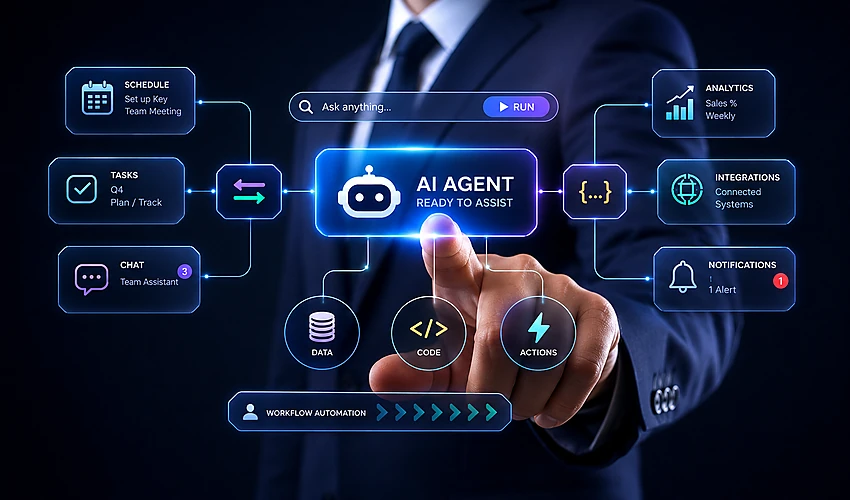
Agentic AI applications may extend across several departments. The most suitable use cases are likely to involve structured, repetitive and information-intensive processes with clear rules.
Customer service
An AI agent could categorise customer enquiries, retrieve account information, suggest a solution, update the customer record and escalate sensitive cases to a human representative.
Sales
Sales agents could help qualify leads, update customer relationship management records, schedule follow-ups and notify sales professionals when a prospect shows strong interest.
Marketing
Marketing agents may monitor campaign performance, identify underperforming advertisements, prepare reports and suggest adjustments for human approval.
Human resources
AI agents could support employee onboarding by sending documents, creating access requests, scheduling orientation sessions and reminding managers about outstanding tasks.
Finance
Finance agents may help match invoices, flag unusual transactions, prepare routine reports and route exceptions to authorised employees for review.
Procurement
Procurement agents could monitor stock levels, compare approved suppliers, prepare purchase requests and track deliveries according to organisational policies.
Operations
Operational agents may monitor performance information, identify delays, coordinate routine responses and alert managers when human intervention is required.
Information technology
IT agents could classify support requests, run approved system checks, suggest fixes and escalate complex cybersecurity or infrastructure issues.
Examples of Agentic AI in Different Industries
Manufacturing
An AI agent could monitor equipment data, identify signs of possible failure, schedule an inspection and check whether the necessary replacement parts are available.
Financial services
Agents could assist with transaction monitoring, compliance checks, customer onboarding and fraud investigations. However, high-impact decisions should remain subject to suitable human and regulatory oversight.
Healthcare
Agentic systems could support appointment scheduling, patient communication, supply management and administrative coordination. Qualified professionals should remain responsible for important clinical decisions.
Retail
Retail agents may monitor customer demand, inventory levels, supplier information and delivery schedules. They could then recommend or initiate approved actions to reduce stock shortages.
Logistics
An AI agent could evaluate delivery conditions, identify potential delays, recommend alternative routes and notify affected customers or suppliers.
What Are the Benefits of Agentic AI in Business?
The potential benefits of Agentic AI in business extend beyond saving time on individual tasks.
Faster business processes
AI agents may move information and actions between approved systems without waiting for every routine handover to be completed manually.
Continuous monitoring
An agent can be configured to monitor relevant business conditions continuously and alert employees when action is required.
Improved consistency
Clearly designed agents can follow the same approved process each time they complete a task.
Better use of employee time
Automating repetitive coordination work may allow employees to focus on relationships, strategy, creativity and complex problem-solving.
Scalable operations
Organisations may be able to handle higher volumes of routine work without increasing administrative workloads at the same rate.
Faster responses
AI agents could help organisations respond more quickly to customer queries, operational disruptions and changing business conditions.
These benefits will depend on the quality of the system, the information it receives and the controls that govern its behaviour.
Can Agentic AI Work Across Enterprise Systems?
Many organisations use separate systems for finance, human resources, customer management, communication, inventory and reporting. Employees often move information manually between these platforms.
Enterprise AI agents may help coordinate approved workflows across several applications. For example, completing a sale may require the organisation to update its CRM, generate an invoice, notify the fulfilment team and schedule customer communication.
An AI agent could support these connected steps. However, the agent would require secure access, clearly defined permissions and accurate information about the organisation’s policies.
This ability to coordinate activity across different systems is one of the key reasons Agentic AI in business is receiving growing attention.
Will Agentic AI Replace Employees?
Agentic AI is more likely to change many jobs than eliminate the need for people completely. Routine monitoring, information transfer and administrative coordination may become increasingly automated.
At the same time, human responsibilities may shift towards supervision, judgement and relationship-based work.
Employees may need to:
- Set appropriate goals for AI agents
- Define acceptable boundaries
- Review important decisions
- Monitor agent performance
- Investigate errors and exceptions
- Protect customers and employees
- Check compliance with organisational policies
- Improve automated workflows over time
Therefore, skills such as critical thinking, communication, ethical judgement, process design and data literacy may become more important.
What Are the Main Agentic AI Risks?
Although Agentic AI offers significant potential, organisations should not introduce autonomous systems without understanding the possible risks.
Incorrect decisions
An agent may take the wrong action when instructions are unclear, information is inaccurate or the system’s reasoning is flawed.
Excessive autonomy
Giving an agent permission to make high-impact decisions without suitable oversight could expose the organisation to financial, ethical or reputational harm.
Cybersecurity threats
Agents that can access several systems may become attractive targets for cybercriminals. Compromised credentials could allow unauthorised activity.
Privacy concerns
AI agents may process sensitive employee, customer or organisational information. Therefore, privacy requirements and access controls must be built into their design.
Bias and unfair outcomes
An agent using biased or incomplete data could reproduce unfair patterns in recruitment, lending, customer service or resource allocation.
Unclear accountability
Organisations must decide who is responsible when an autonomous system makes an error. Accountability cannot be transferred entirely to the technology.
Overdependence
Employees may lose important knowledge or fail to question automated decisions when they become too dependent on the system.
Why Agentic AI Governance Is Essential
Agentic AI governance refers to the policies, responsibilities and controls that guide how AI agents are developed and used.
Effective governance should establish:
- Which processes may use AI agents
- What information each agent may access
- Which actions an agent may complete
- When human approval is required
- How decisions and actions are recorded
- Who monitors the agent’s performance
- How errors and harmful outcomes are corrected
- When an agent should be paused or disabled
Human oversight should reflect the level of risk involved. An agent that schedules an internal meeting does not require the same level of control as one involved in payments, employment or access to essential services.
Responsible governance allows organisations to explore the benefits of Agentic AI in business without removing human accountability.
Why Data Quality Matters
Agentic systems depend on data to understand conditions and select actions. If the information is outdated, incomplete or incorrect, the agent may make poor decisions quickly and repeatedly.
Before implementing autonomous agents, organisations should assess:
- Where important data is stored
- Whether the information is accurate and current
- Who owns and maintains the data
- Which systems may share information
- How sensitive information will be protected
- Whether decisions can be explained and audited
Strong data governance is one of the foundations of safe and reliable Agentic AI.
How Can Businesses Prepare for Agentic AI?
1. Identify the right process
Start with a clearly defined workflow that is repetitive, measurable and governed by established rules. Avoid beginning with the organisation’s most sensitive decision.
2. Map the existing workflow
Document each step, system, approval and exception before attempting to automate the process.
3. Improve data quality
Review the accuracy, availability and ownership of the information the agent will use.
4. Define boundaries
Specify what the agent may do, what it may not do and when it must request human approval.
5. Strengthen cybersecurity
Use secure authentication, access controls, activity logs and regular testing to protect connected systems.
6. Test in a controlled environment
Run a limited pilot before allowing the agent to work across a wider part of the organisation.
7. Train employees
Employees need to understand how the system works, how to supervise it and how to report unexpected outcomes.
8. Measure business value
Track outcomes such as turnaround time, error rates, customer experience, employee workload, cost and compliance.
9. Review the system continuously
Agent performance should be monitored after implementation because business processes, risks and operating conditions may change.
What Skills Will Business Leaders Need?
Introducing Agentic AI in business is not solely an information technology project. Business leaders also need enough knowledge to make informed decisions about strategy, governance, risk and workforce development.
Important capabilities include:
- AI and data literacy
- Business-process analysis
- Strategic decision-making
- Risk and governance awareness
- Change management
- Ethical judgement
- Performance measurement
- Cross-functional collaboration
Leaders do not necessarily need to become software engineers. However, they should understand what Agentic AI can do, where it may fail and how responsibility should be shared between people and technology.
Build Practical Agentic AI Skills
As organisations move from experimenting with chatbots to redesigning complete workflows, professionals will need practical knowledge of AI agents, automation platforms and responsible implementation.
The Regenesys AI Agentic Programme is designed to help professionals and business leaders understand AI agents and apply agent-based automation to organisational functions.
The programme explores areas such as AI-agent fundamentals, workflow automation, enterprise applications, governance, responsible AI and implementation strategy.
This makes it relevant to professionals who want to move beyond basic prompting and understand how AI can support wider business transformation.
Conclusion
Agentic AI in business marks a shift from systems that generate information to systems that can help coordinate and complete actions. Generative AI has already improved individual productivity, but Agentic AI could influence complete workflows by planning, using tools and executing approved tasks.
Its potential applications extend across customer service, finance, sales, procurement, human resources, operations and supply-chain management. However, increased autonomy also creates greater responsibility.
Organisations will need secure systems, reliable data, clear governance and employees who can supervise intelligent agents effectively. Those that combine innovation with responsible oversight will be better positioned to turn Agentic AI into a practical business capability.
Explore the AI Agentic Programme at Regenesys School of AI to learn how intelligent agents and automated workflows can be applied across business functions.
Frequently Asked Questions
1. What is Agentic AI in simple terms?
Agentic AI refers to artificial intelligence that can work towards a goal by planning steps, using approved tools and completing actions. Unlike a basic chatbot, it may coordinate several tasks within one workflow.
2. How is Agentic AI different from Generative AI?
Generative AI primarily creates content in response to prompts. Agentic AI can use information, make a plan and complete approved actions across connected systems. Generative AI may also form part of an Agentic AI workflow.
3. How will Agentic AI transform business?
Agentic AI could transform business by automating multi-step processes, connecting enterprise platforms, monitoring changing conditions and reducing delays between information, decisions and action.
4. What are some Agentic AI use cases?
Potential use cases include customer-service coordination, employee onboarding, invoice processing, inventory monitoring, procurement, sales follow-ups, campaign reporting and IT-support workflows.
5. What are the main risks of Agentic AI?
The main risks include incorrect decisions, excessive system access, cybersecurity threats, privacy breaches, biased outcomes and unclear accountability. Human oversight and governance are therefore essential.
6. Will Agentic AI replace human workers?
Agentic AI is likely to automate parts of many jobs rather than remove every role. Employees may spend less time on repetitive coordination and more time on judgement, relationships, creativity and system supervision.
7. How can an organisation prepare for Agentic AI?
An organisation can begin by selecting a suitable process, improving its data, defining permissions, strengthening security, testing a limited pilot and training employees to monitor the system.
8. Do business professionals need coding skills to learn Agentic AI?
Not every business professional needs advanced coding skills. Many workflows can be designed using no-code or low-code platforms. However, professionals still need to understand process design, governance, risk and effective human oversight.