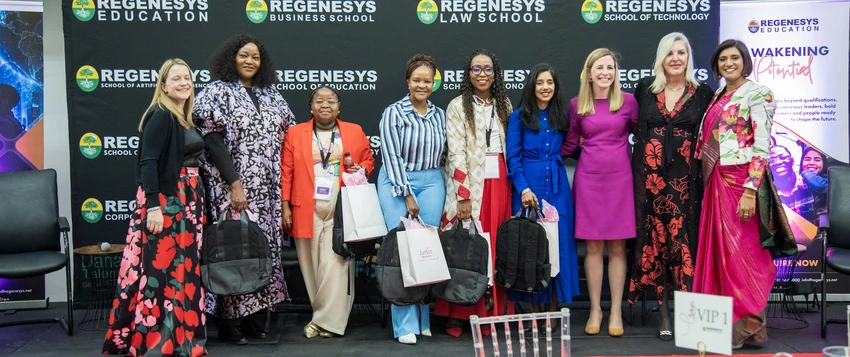

Earlier this month, we brought together women from business, government and technology at the Regenesys Women in Business and Leadership Conference.
The theme was “Women in AI & Business: Empowering Change, Innovation and Inclusive Leadership.”
There were many conversations throughout the day, but one idea kept coming through: getting women into technology is only the beginning.
For years, much of the conversation around women in tech has focused on access. We need more women studying technology. More women entering the industry. More women learning digital skills.
All of that matters. But once women have access, what happens next?
Are they getting the opportunity to lead teams? Are they building companies? Are they accessing funding? Are they developing the products we use? Are they sitting in the rooms where decisions about AI are being made? That is where the conversation needs to go now.
Table of Contents
Women should not just use technology

AI is changing almost every industry, and quickly. We are already seeing it influence how companies recruit, market, analyse information, serve customers and make decisions. There is no question that women need the skills to participate in this new economy. But participation cannot be the end goal.
One of the comments that stood out at the conference came from Shiphra Chisha, Chief Executive Officer of the Graça Machel Trust:
“In the age of AI, women must be architects of innovation, not merely its beneficiaries.”
That is the difference. It is one thing to teach a woman how to use an AI tool. It is another to give her the opportunity to build a business with it, lead the team developing it or influence how it is used. Women need a seat at the table, yes. But they also need a say in what happens at that table. Because AI is not automatically fair There is sometimes an assumption that technology is neutral. It isn’t.
AI learns from information created by people and institutions over many years. If that information reflects the biases and inequalities that already exist in society, those same problems can show up in the technology.
Denise Mukozho, Digital and Product Delivery Leader at Bizmod and Chairperson of the IITPSA Women in IT Chapter, put it simply:
“Artificial intelligence does not invent exclusion; it remembers it.”
That is something business leaders should be thinking about now, not five years from now. If women are absent when these systems are developed, tested and governed, we risk building new technology on top of old inequalities. This is why having more women in tech is not just a gender issue. It is also about building better businesses and better technology.
Different experiences lead to different questions being asked. Different problems being noticed. Different solutions being considered.
Why is Regenesys part of this conversation?
We are part of this conversation because education has to be about more than giving someone a qualification and wishing them luck. If we are preparing people for the future of work, we also have to think about whether they will have a fair opportunity to participate in that future. For women, that means access to digital and AI skills, but it also means access to networks, mentorship, funding, employment and leadership opportunities.
At the conference, 25 guests received access to AI Fundamentals and Prompt Engineering courses through a raffle. It was one small part of a much bigger conversation, but it matters. Skills can open a door. What matters next is whether there is a real opportunity on the other side.
From access to ownership

Perhaps this is where the women-in-tech conversation needs to shift. We should absolutely keep encouraging girls and women to study technology. We should keep celebrating women succeeding in the industry. But we should also start asking tougher questions.
How many women are building technology businesses?
How many are accessing investment?
How many are leading AI projects?
How many are making decisions about the technology their organisations use?
And how many actually own a meaningful part of the value being created?
Women do not need to arrive at the AI revolution once everything has already been built.
They need to be part of building it.
That is the opportunity in front of us now.
Access was the first step. Ownership, influence and leadership must be the next.
At Regenesys, preparing students for the future also means preparing them for a world where AI will be part of almost every profession. That is why every Regenesys programme includes a compulsory AI module. And for those who want to build deeper expertise in data, analytics and AI, our Postgraduate Diploma in Data Science offers a focused pathway into this growing field.