

AI in telemedicine is changing how healthcare professionals deliver virtual care, monitor patients and assess clinical information. By combining telemedicine with intelligent digital systems, healthcare organisations can improve access, identify important patterns and support more informed decisions.
However, responsible adoption requires more than introducing new software. Healthcare professionals must also consider patient safety, clinical limitations, data protection, ethics and the continuing importance of human judgement.
Professionals who want to understand these developments can explore the Telehealth and AI in Practice programme offered by the Regenesys School of Health Sciences. This three-day programme introduces virtual consultations, AI-supported decision-making, remote patient monitoring and the ethical use of digital health tools in clinical and non-clinical environments.
This article explains what AI in telemedicine means, how it works, its most important applications and the challenges healthcare organisations must address.
What is AI in telemedicine?
AI in telemedicine refers to the use of artificial intelligence within remotely delivered healthcare services.
Telemedicine generally involves clinical consultations and related services delivered through video calls, mobile applications, telephone systems or other connected platforms. Artificial intelligence can support these services by analysing information, detecting patterns, automating routine processes and highlighting cases that may require professional attention.
Therefore, AI does not replace telemedicine. Instead, it adds analytical and automation capabilities to virtual healthcare.
Common applications include:
- Virtual symptom assessment
- Remote patient monitoring
- Clinical decision support
- Medical image analysis
- Predictive risk modelling
- Appointment and workflow automation
- Clinical documentation assistance
- Automated patient follow-up
AI in Telemedicine vs Telehealth: What is the Difference?
Although people often use these terms interchangeably, they can have different meanings.
Telemedicine generally refers to clinical healthcare delivered remotely. This may include consultations, follow-up appointments, treatment discussions and remote monitoring.
Telehealth, however, is broader. In addition to clinical care, it may include healthcare education, administration, professional training and public-health communication.
Consequently, AI in telemedicine usually refers to intelligent systems supporting remote clinical care. Meanwhile, AI in telehealth may include a wider range of clinical, educational and operational applications.
How is AI used in telemedicine?
AI can support different stages of the patient journey. Nevertheless, its effectiveness depends on the quality of the technology, available data and clinical oversight.
1. Virtual symptom assessment
AI-enabled platforms can ask patients structured questions about their symptoms, medical history and risk factors.
Based on the answers, the system may:
- Recommend an appropriate care pathway
- Identify potentially urgent symptoms
- Suggest whether a virtual consultation is suitable
- Direct the patient towards emergency or in-person care
However, these tools should not automatically be treated as diagnostic authorities. Their outputs depend on the quality of the data, the design of the system and the information supplied by the patient.
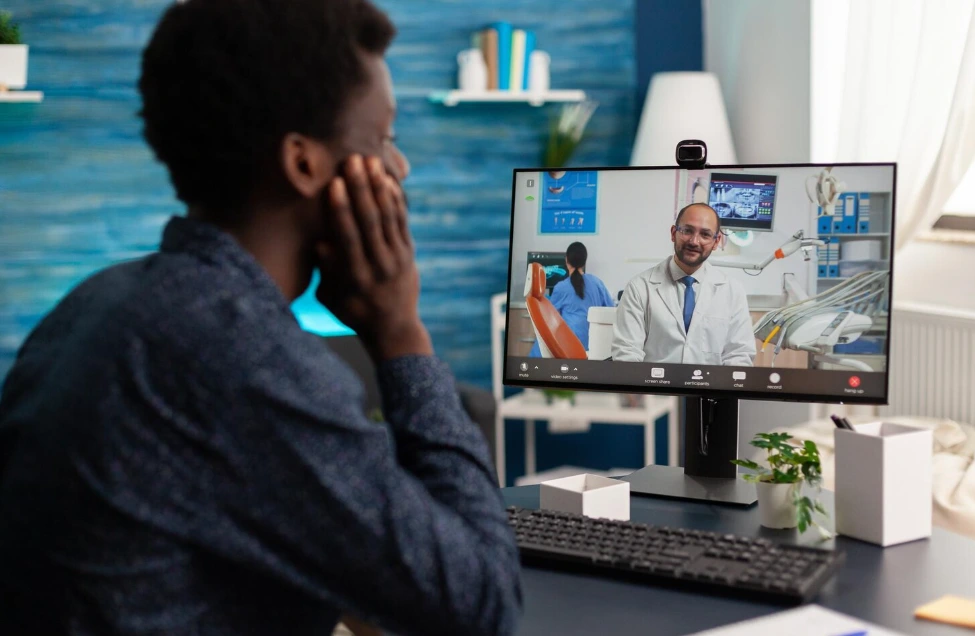
2. Clinical decision support
During or after a virtual consultation, AI can help organise and interpret relevant clinical information.
For example, an AI tool may identify patterns in a patient’s records, compare findings with clinical criteria or flag possible risks for professional review.
In this context, the system supports the healthcare professional. It does not replace professional accountability or clinical reasoning.
3. Remote patient monitoring
Remote patient monitoring uses connected devices to collect health information while the patient is outside a hospital or clinic.
Depending on the patient’s condition, devices may measure:
- Heart rate
- Blood pressure
- Blood glucose
- Oxygen saturation
- Body temperature
- Activity levels
- Sleep patterns
- Medication adherence
AI can then analyse the incoming information and detect changes that may be difficult to identify from occasional readings alone.
As a result, healthcare teams may receive an alert when readings move outside defined limits or when a patient’s risk profile changes.
However, successful implementation requires reliable devices, appropriate clinical protocols and clear responsibility for responding to alerts.
4. Medical image and signal analysis
AI may also assist with the analysis of medical images and physiological signals.
For instance, intelligent systems may help identify patterns in:
- Radiology images
- Retinal scans
- Skin images
- Electrocardiograms
- Digitally recorded clinical data
The US Food and Drug Administration’s information on AI-enabled medical devices explains how authorised medical devices increasingly incorporate artificial intelligence and machine learning.
Nevertheless, healthcare professionals must still review results in the context of the patient’s complete clinical situation.
5. Clinical documentation
Virtual consultations may create extensive administrative work. Therefore, some AI tools support:
- Transcription
- Consultation summaries
- Medical note preparation
- Coding assistance
- Patient instructions
- Follow-up communication
Used responsibly, these tools may reduce repetitive administrative pressure.
However, healthcare professionals should review AI-generated content before adding it to a patient’s official record.
6. Patient communication and follow-up
AI-enabled communication systems can answer routine questions, send reminders and provide general follow-up information.
For example, a system may remind a patient to:
- Attend an appointment
- Take medication
- Record a health measurement
- Complete a health questionnaire
- Contact a healthcare professional when warning signs appear
Even so, patients should understand when they are interacting with an automated system and how to reach a qualified professional.
What are the benefits of AI in telemedicine?
The benefits of AI in telemedicine depend on whether the technology is appropriate, reliable and well integrated into healthcare practice.
Improved access to healthcare
Telemedicine can reduce geographical barriers by enabling patients to consult healthcare professionals remotely.
Furthermore, AI-supported systems may help organise requests, identify urgent cases and direct patients towards the appropriate type of care.
This may be particularly valuable in areas where specialist healthcare services are limited.
However, access still depends on reliable connectivity, suitable devices, affordability and digital literacy.
Faster analysis of health information
Healthcare professionals often work with large quantities of patient information.
AI can help organise this data and highlight patterns that require attention. Consequently, clinicians may identify relevant information more quickly.
Nevertheless, speed should not replace professional verification.
More continuous monitoring
Traditional appointments provide information from specific moments in time.
By contrast, connected devices can provide a more continuous view of selected health indicators. Therefore, AI-supported monitoring may help healthcare teams detect changes between consultations.
This may be particularly valuable for chronic-condition management and post-discharge care.
More efficient use of resources
AI may automate repetitive administrative tasks, support patient triage and reduce unnecessary manual processing.
As a result, healthcare professionals may have more time for tasks requiring empathy, communication and complex clinical reasoning.
Support for predictive healthcare
Predictive healthcare uses current and historical data to estimate the likelihood of future health events.
For example, a predictive system may identify a patient who appears to be at increased risk of deterioration, complications or hospital readmission.
The healthcare team can then assess the result and determine whether early intervention is appropriate.
However, a prediction is not a certainty. It is a probability that must be interpreted within the patient’s wider clinical context.
How AI in Telemedicine Supports Digital Health
Digital health is broader than AI or telemedicine alone. It can include electronic health records, mobile health platforms, connected medical devices, interoperability and artificial intelligence.
The World Health Organization’s digital health resources explain that digital technologies can support more accessible, efficient and sustainable health systems. However, successful adoption also depends on governance, infrastructure and equity.
Therefore, healthcare organisations should not introduce AI as an isolated technology project.
Instead, they should consider:
- Clinical needs
- Patient experience
- Data quality
- System interoperability
- Staff readiness
- Cybersecurity
- Legal obligations
- Long-term cost
- Health equity
A technically advanced platform may still fail if it does not address a meaningful healthcare need or fit existing workflows.
Challenge and Risks of AI-based telemedicine
Although AI creates important opportunities, healthcare organisations must also address significant risks.
Data privacy and cybersecurity
Telemedicine systems may process sensitive health, identity and communication data.
Therefore, healthcare organisations need clear controls for:
- Collecting data
- Storing information
- Managing access
- Transmitting records
- Obtaining consent
- Responding to data breaches
- Assessing third-party providers
Patients should also understand how their data will be used.
Algorithmic bias
AI systems may perform differently across populations when training data are incomplete or unrepresentative.
For example, a model developed using information from one population may not perform equally well for patients from another demographic, geographical or clinical background.
Consequently, organisations must assess whether a system is appropriate for the population it will serve.
Limited explainability
Some AI systems generate recommendations without making their reasoning easy to understand.
This can be problematic in healthcare, where professionals and patients may need to understand why a risk score or recommendation was produced.
The World Health Organization’s guidance on AI ethics and governance highlights principles such as transparency, explainability, accountability, autonomy, safety and inclusiveness.
Overreliance on automated recommendations
Automation bias occurs when a person accepts an automated recommendation without applying sufficient independent judgement.
For this reason, healthcare professionals must understand both the capabilities and limitations of AI.
They should know when to question a result, request further information or proceed without the system’s recommendation.
Poor integration with existing systems
AI tools may provide limited value if they cannot communicate with electronic health records, monitoring platforms or other clinical systems.
Therefore, interoperability is essential.
Without proper integration, healthcare professionals may have to enter the same information repeatedly or work across several disconnected platforms.
Connectivity and infrastructure limitations
Telemedicine depends on stable digital infrastructure.
In South Africa and other countries with unequal digital access, patients may experience:
- Unreliable internet access
- High mobile-data costs
- Limited access to suitable devices
- Power interruptions
- Low digital confidence
Therefore, equitable implementation may require telephone-based and in-person options alongside advanced digital platforms.
Regulatory and professional accountability
Healthcare organisations must establish who remains responsible when AI contributes to a clinical decision.
They must also determine:
- Whether the tool requires medical-device approval
- Who monitors system performance
- How errors will be reported
- Who reviews patient alerts
- When human intervention is mandatory
Therefore, clear governance should be established before AI systems are used in patient care.
Can AI in Telemedicine Replace Healthcare Professionals
AI should not be presented as a replacement for appropriately qualified healthcare professionals.
Healthcare requires ethical responsibility, communication, contextual understanding and clinical judgement.
An AI system may recognise patterns in information. However, it does not automatically understand the patient’s complete emotional, social and clinical circumstances.
Instead, AI can support professionals by helping them:
- Access relevant information
- Identify patterns
- Reduce repetitive administrative work
- Monitor patients more consistently
- Make better-informed decisions
The most responsible model is therefore human expertise supported by technology.
Skills needed for telehealth and AI
Healthcare professionals do not necessarily need to become software developers to use AI-supported telemedicine.
However, they increasingly need practical digital skills, including the ability to:
- Conduct professional virtual consultations
- Evaluate digital information
- Interpret AI-supported outputs
- Recognise limitations and bias
- Protect patient information
- Communicate effectively through digital channels
- Escalate cases appropriately
- Maintain patient-centred care
The Telehealth and AI in Practice programme provides a structured introduction to telehealth, AI-supported decision-making, remote monitoring and responsible digital healthcare practice.
Prospective learners can also explore the Regenesys School of Health Sciences for additional healthcare-focused programmes and professional development opportunities.
The future of AI in telemedicine
The future of telemedicine is likely to involve closer integration between virtual consultations, connected devices, electronic records and decision-support technologies.
Nevertheless, progress should not be measured only by the sophistication of the technology.
Healthcare organisations should also consider whether the technology:
- Improves patient safety
- Supports equitable access
- Protects patient autonomy
- Strengthens healthcare professionals
- Fits clinical workflows
- Produces reliable results
- Creates measurable patient value
Therefore, the future of AI in telemedicine will depend as much on governance, professional education and public trust as it does on technological innovation.
Conclusion
AI in telemedicine can support virtual consultations, remote patient monitoring, predictive healthcare, clinical documentation and professional decision-making.
However, technology alone cannot guarantee better healthcare.
Organisations must combine reliable systems with qualified professionals, ethical governance, high-quality data and patient-centred implementation.
Ultimately, the goal is not to make healthcare less human. Instead, it is to use technology responsibly so that healthcare professionals can deliver safer, more accessible and better-informed care.
Frequently asked questions
What is AI in telemedicine?
AI in telemedicine is the use of artificial intelligence within remotely delivered healthcare services. It may support virtual symptom assessment, patient monitoring, clinical decisions, documentation and follow-up communication.
How is AI used in telemedicine in South Africa?
In South Africa, AI may support virtual consultations, remote patient monitoring, digital administration, patient triage and health-data analysis. However, implementation must consider local healthcare regulations, connectivity, affordability and data protection.
What are the benefits of AI in telemedicine for rural communities?
AI-supported telemedicine may help rural patients access remote consultations, specialist support and ongoing monitoring without travelling long distances. However, the benefits depend on reliable connectivity, suitable devices and pathways for in-person care when needed.
Can AI diagnose patients during virtual consultations?
Some AI systems can assess symptoms, images or health information and provide decision support. However, an AI output should not automatically be treated as a final diagnosis. A qualified healthcare professional must interpret the result within the patient’s clinical context.
What qualifications are needed to work in telehealth and AI?
Requirements depend on the role. Clinical positions require relevant healthcare qualifications and professional registration. Other roles may involve data, technology, administration or digital-health implementation. Short programmes can help professionals develop practical knowledge of telehealth and AI.
Where can professionals study telehealth and AI in South Africa?
Professionals can study through the Regenesys Telehealth and AI in Practice programme. The three-day programme covers virtual consultations, AI-supported decisions, remote monitoring and ethical considerations.