
Every business wants to use artificial intelligence, but not every business knows how to turn AI into something useful. That is where the Artificial Intelligence Software Developer becomes important. This role is not just about writing code. It is about building intelligent applications that can learn from data, automate tasks, support decision-making and solve real-world problems. An Artificial Intelligence Software Developer sits at the intersection of software engineering, data, machine learning, business thinking and responsible technology use.
Table of Content
In the past, software developers mainly built applications by writing logic that followed fixed instructions. Today, AI-powered applications can analyse patterns, respond to users, recommend actions and improve workflows. This shift is changing what businesses need from technology professionals. The question is no longer only, “Can you code?” The better question is, “Can you build software that uses AI intelligently, safely and practically?”
For learners who want to prepare for this future, the Artificial Intelligence Software Developer programme offers a practical pathway into a career shaped by intelligent systems, automation and digital innovation.
What Is an Artificial Intelligence Software Developer?
An Artificial Intelligence Software Developer is a technology professional who designs, builds, tests and improves software applications that use artificial intelligence.
This can include applications that:
- Automate repetitive work
- Analyse large amounts of data
- Recognise patterns
- Make predictions
- Respond to users through chatbots
- Recommend products or actions
- Process text, images or speech
- Support business decision-making
- Improve digital customer experiences
The simplest way to understand the role is this: a traditional software developer builds applications that follow instructions, while an Artificial Intelligence Software Developer builds applications that can use data and AI models to produce smarter outcomes.
That does not mean AI developers stop using normal coding skills. They still need programming, databases, APIs, testing, debugging and software design. The difference is that they also need to understand AI tools, machine learning concepts, data quality, model behaviour and the risks of AI-generated outputs. This makes the role both technical and strategic.
What Does an Artificial Intelligence Software Developer Do?
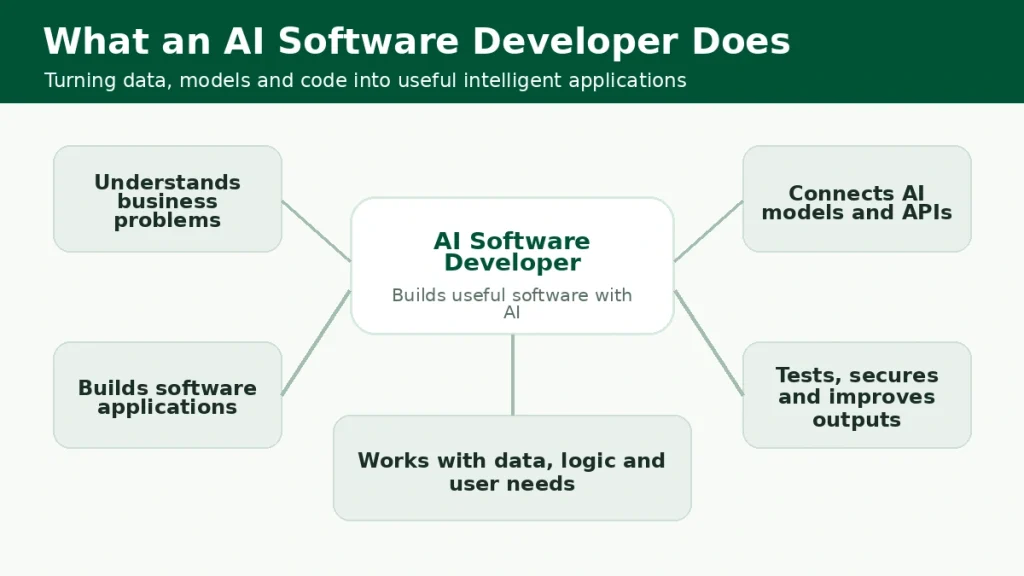
An Artificial Intelligence Software Developer turns ideas into working AI-powered software.
Their daily tasks may include writing code, connecting applications to AI models, preparing data, testing outputs, integrating APIs, reviewing system performance and improving how an intelligent application behaves.
For example, a business may want to build a chatbot that helps customers answer basic questions. The Artificial Intelligence Software Developer would not only write the code for the chatbot interface. They would also consider what data the chatbot needs, how it should respond, how to prevent incorrect answers, how to protect user information and how to measure whether it is actually helping customers.
In another case, a company may want to predict when stock will run low. An AI software developer could help build an application that analyses sales patterns, stock levels and seasonal demand to produce smarter inventory alerts.
The role usually involves five core responsibilities.
First, the developer understands the business problem. AI should not be added just because it sounds impressive. It must solve a real problem.
Second, the developer designs the software solution. This includes choosing the right architecture, tools, models and integrations.
Third, the developer builds the application. This may involve coding interfaces, backend systems, workflows, APIs and data pipelines.
Fourth, the developer tests the system. AI outputs must be checked for accuracy, bias, reliability, security and usefulness.
Finally, the developer improves the system over time. AI-powered software is not a once-off build. It needs monitoring, updates and continuous improvement.
Why the Role Matters in Today’s Business World
Artificial intelligence is becoming part of normal business operations. It is used in customer service, marketing, banking, healthcare, logistics, education, cybersecurity, human resources and public services.
But AI only creates value when it is built into usable systems. A business does not benefit from AI because it has a model sitting somewhere in the background. It benefits when that model is connected to a practical application that employees, customers or decision-makers can use.
That is why Artificial Intelligence Software Developers are becoming so valuable. They bridge the gap between AI theory and real-world software. The Stack Overflow Developer Survey 2025 found that 84% of respondents were already using or planning to use AI tools in their development process, while 51% of professional developers were using AI tools daily. At the same time, the survey showed that developers remain cautious about trusting AI outputs.
This tells us something important. AI is already part of software development, but human judgment still matters. Businesses need professionals who can use AI tools, but also question them. They need developers who can build fast, but not carelessly. They need people who understand both opportunity and risk.
Artificial Intelligence Software Developer vs Software Developer
A software developer builds applications, websites, systems and digital tools. An Artificial Intelligence Software Developer does that too, but with an added AI layer. The difference is not that one codes and the other does not. Both need coding skills. The difference lies in the type of problems they solve.
A traditional software developer may build a booking system where users select available dates and make reservations. An Artificial Intelligence Software Developer may build a booking system that predicts busy periods, recommends time slots, detects unusual behaviour or supports automated customer responses.
A traditional software developer may create a reporting dashboard. An AI software developer may build a dashboard that analyses trends and suggests what managers should pay attention to next. The AI developer’s work is shaped by data, models and intelligent automation.
In practical terms, an Artificial Intelligence Software Developer needs to understand:
- How software applications are built
- How AI models work at a basic level
- How data affects outputs
- How to integrate AI tools and APIs
- How to test AI-powered features
- How to manage risks such as bias, security and poor accuracy
This makes the role more complex, but also more future-focused.
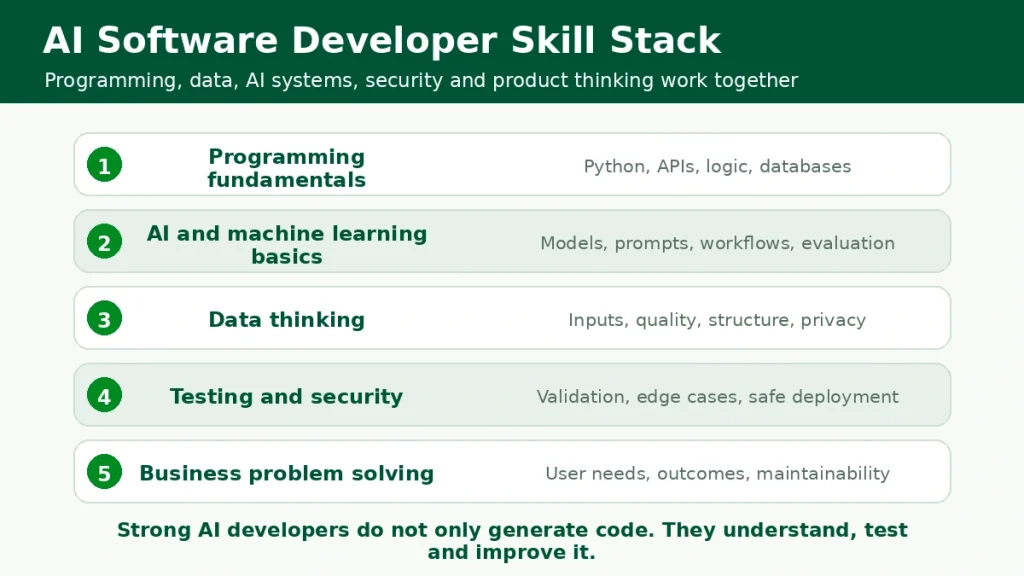
Key Skills Needed to Become an Artificial Intelligence Software Developer
The best Artificial Intelligence Software Developers are not people who only know how to prompt AI tools. They are people who understand the foundations beneath the tools.
Programming Skills
Programming is still the base of the role. Python is especially useful because it is widely used in AI, data science and automation. However, learners may also benefit from understanding JavaScript, APIs, databases and web development.
The goal is not only to write code. The goal is to understand how code behaves, how systems connect and how software can be maintained.
Data Understanding
AI depends on data. Poor data can lead to poor outputs, no matter how advanced the model is. An AI software developer must understand how data is collected, cleaned, structured and used. They should know why missing data, biased data or badly labelled data can affect the performance of an AI-powered system.
Machine Learning Basics
An Artificial Intelligence Software Developer does not always need to be a machine learning researcher. However, they should understand key concepts such as training data, models, predictions, classification, natural language processing and evaluation. This helps them build software that uses AI more responsibly.
API and Integration Skills
Many AI-powered applications use external models and services through APIs. Developers need to know how to connect systems, send data securely, receive outputs and handle errors. This is a major part of real-world AI software development.
Testing and Debugging
AI applications must be tested differently from traditional software. It is not enough to check whether the application runs. Developers must also check whether the AI output is useful, accurate, safe and consistent. Testing is where responsible AI development becomes practical.
Cybersecurity Awareness
AI-powered systems can create new security risks. The OWASP Top 10 for Large Language Model Applications highlights risks such as prompt injection, insecure output handling, sensitive information disclosure and supply chain vulnerabilities.
An Artificial Intelligence Software Developer must understand how to reduce these risks before an application reaches users.
Business Thinking
The strongest developers do not build technology for its own sake. They understand why the software matters. Business thinking helps developers ask better questions.
- What problem are we solving?
- Who will use this system?
- What decision should it support?
- What happens if the output is wrong?
- How will success be measured?
These questions separate useful AI software from impressive but pointless technology.
Tools Used by Artificial Intelligence Software Developers
Artificial Intelligence Software Developers use a mix of traditional development tools and AI-specific tools.
These may include code editors, version control platforms, databases, cloud services, machine learning libraries, AI APIs, testing tools and monitoring platforms.
Common tool categories include:
- Code editors and development environments
- AI coding assistants
- Python libraries
- Machine learning frameworks
- Cloud platforms
- API testing tools
- Database systems
- Version control platforms
- Model monitoring tools
- Cybersecurity testing tools
AI coding assistants can help developers work faster by suggesting code, explaining errors and generating first drafts. But they do not replace understanding. A developer who blindly copies AI-generated code is not building skill. They are building dependency.
The real advantage comes from knowing how to use AI tools while still reviewing, testing and improving the output.
Career Opportunities for Artificial Intelligence Software Developers
AI software development opens several career possibilities. A learner may start in a junior development role and grow into AI application development. Others may move into machine learning engineering, automation development, software testing, DevOps, AI product development or technical consulting.
Possible roles include:
- Artificial Intelligence Software Developer
- AI Application Developer
- Junior Software Developer
- Python Developer
- Full Stack Developer with AI skills
- Machine Learning Developer
- AI Solutions Developer
- Software Tester or QA Analyst
- Automation Developer
- Technical Support Engineer for AI applications
The career outlook is promising because businesses still need software professionals. The US Bureau of Labor Statistics projects 15% growth for software developers, quality assurance analysts and testers from 2024 to 2034, which is much faster than the average for all occupations.
The World Economic Forum Future of Jobs Report 2025 also points to rising demand for technology-related skills, including AI, big data and software-related roles. This does not mean every person with basic AI knowledge will automatically get a job. It means the market is moving towards people who can combine software ability with AI capability.
Is an Artificial Intelligence Software Developer a Good Career?
Yes, Artificial Intelligence Software Developer can be a strong career path for people who enjoy technology, problem-solving and continuous learning.
The role is valuable because it connects directly to what businesses are trying to achieve. Companies want to automate processes, reduce costs, improve customer service, analyse data, build smarter platforms and make faster decisions. AI software developers help make those goals practical.
However, this career is not for someone who wants to learn once and stop. AI changes quickly. Tools improve, models evolve and business expectations shift. The best developers keep learning. This is why structured training matters. Learners need more than random online tutorials. They need a foundation that builds coding ability, AI understanding and practical project experience.
The Artificial Intelligence Software Developer programme is designed to help learners build hands-on AI software development capabilities for real-world applications. Learners who want broader exposure to AI learning pathways can also explore the Regenesys School of AI and the AI for Developers programme.
How to Become an Artificial Intelligence Software Developer
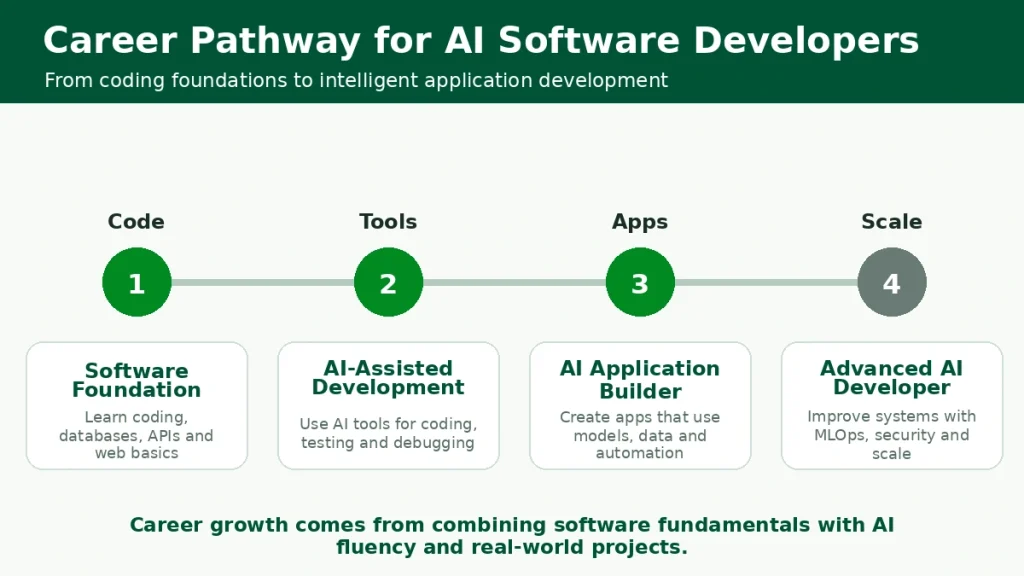
The path to becoming an Artificial Intelligence Software Developer starts with strong foundations.
First, learn programming. Start with a language such as Python and understand the basics of logic, functions, data structures and debugging.
Second, build small projects. Theory becomes useful when you apply it. Create simple applications, connect to APIs and practise solving real problems.
Third, learn the basics of artificial intelligence. Understand machine learning, natural language processing, data preparation and model evaluation.
Fourth, learn how to use AI tools responsibly. Use coding assistants, but do not let them think for you. Ask why the code works. Test it. Break it. Improve it.
Fifth, build a portfolio. Employers and clients want proof. A portfolio can show chatbots, automation tools, predictive applications, dashboards or AI-powered workflows.
Finally, choose a structured learning pathway. A focused programme can help learners avoid confusion and build skills in the right order.
For those who prefer flexible online learning, the Digital Regenesys Artificial Intelligence Course introduces practical AI skills through guided learning. Professionals interested in organisational AI adoption can also explore Regenesys Corporate Education, which supports workforce development across leadership, management and digital skills.
Mistakes to Avoid When Starting This Career
Many beginners make the mistake of jumping straight into advanced AI without understanding basic software development. This creates weak foundations.
Another mistake is relying too heavily on AI tools. AI can help you learn, but it can also hide what you do not understand.
A third mistake is ignoring security. AI-powered applications often handle data, user inputs and external services. Developers must think carefully about privacy, access and misuse.
The fourth mistake is building projects with no business value. A project should not only show that you can use AI. It should show that you can solve a meaningful problem.
The final mistake is thinking AI software development is only about models. In reality, the model is often just one part of the system. The application, data flow, user experience, testing and deployment are just as important.
Why Artificial Intelligence Software Developers Will Shape the Future of Digital Business
The Artificial Intelligence Software Developer is becoming one of the most important roles in the modern technology landscape.
Businesses do not only need people who understand AI theory. They need people who can build working systems. They need professionals who can connect AI to real business problems, create usable applications, test outputs, protect data and improve performance over time. That is what makes this role powerful.
An Artificial Intelligence Software Developer is not simply a coder. This person is a builder of intelligent tools, a translator of business needs and a guardian of responsible AI use. As more organisations adopt AI, the demand will grow for professionals who can move beyond hype and create practical value. The future will favour people who understand both software and intelligence, both automation and accountability, both speed and quality.
For learners ready to enter this space, the Artificial Intelligence Software Developer programme offers a practical route into a career built for the AI era.
FAQs About Artificial Intelligence Software Developers
What is an Artificial Intelligence Software Developer?
An Artificial Intelligence Software Developer is a professional who builds software applications that use AI technologies such as machine learning, natural language processing, automation and data-driven decision-making.
What does an Artificial Intelligence Software Developer do?
An Artificial Intelligence Software Developer designs, codes, tests and improves AI-powered applications. They may work with data, APIs, AI models, software interfaces, testing tools and business requirements.
Do I need coding skills to become an Artificial Intelligence Software Developer?
Yes. Coding is an important foundation. AI tools can assist with development, but developers still need to understand programming, logic, debugging, APIs and software design.
Is AI software development difficult?
It can be challenging because it combines software development, data, AI concepts, testing and problem-solving. However, learners can build these skills step by step through structured training and practical projects.
What skills are needed for AI software development?
Important skills include programming, Python, data understanding, machine learning basics, API integration, testing, cybersecurity awareness, communication and business problem-solving.
Where can I study Artificial Intelligence Software Development?
You can explore the Artificial Intelligence Software Developer programme from Regenesys Skills Academy. It is designed to help learners build practical AI software development skills for real-world applications.