
Software development used to reward the person who could write the cleanest code from scratch. Today, that is no longer enough. The new advantage belongs to people who can think clearly, use AI tools responsibly, test what those tools produce, and build software that actually solves business problems. AI can now help write code, explain errors, generate tests, improve documentation, review security patterns, and speed up repetitive development work. But it can also create weak code, hide mistakes, introduce security risks, and make inexperienced developers overconfident.
Table of Content
That is why the conversation around AI in software development needs to move beyond hype. The real question is not whether AI will change software development. It already has. The better question is: who will know how to use it well?
For businesses, this affects productivity, cybersecurity, software quality, and hiring. For aspiring developers, it affects the skills needed to enter and grow in the profession. For learners who want structured preparation, the Artificial Intelligence Software Developer programme offers a practical pathway into one of the most important technology fields of the decade.

What Is AI in Software Development?
AI in software development refers to the use of artificial intelligence tools and systems across the software development lifecycle. This includes planning, coding, testing, debugging, documentation, deployment, monitoring, and security review.
It is not only about asking a chatbot to write a function.
Modern AI development tools can assist with several tasks, including:
- Generating code from natural language prompts
- Suggesting improvements inside code editors
- Explaining unfamiliar code
- Creating unit tests
- Finding bugs
- Summarising logs
- Writing technical documentation
- Translating code between languages
- Helping developers build AI-powered applications
This changes the developer’s role. Instead of spending all their time producing code manually, developers increasingly guide, review, refine, and validate AI-assisted outputs.
That shift sounds simple, but it is massive. When code becomes easier to generate, the real value moves to judgement. Developers must understand whether the code is correct, secure, maintainable, scalable, and aligned with the business goal.
In other words, AI in software development does not remove the need for developers. It raises the standard of what good developers must know.
Why AI in Software Development Matters Now
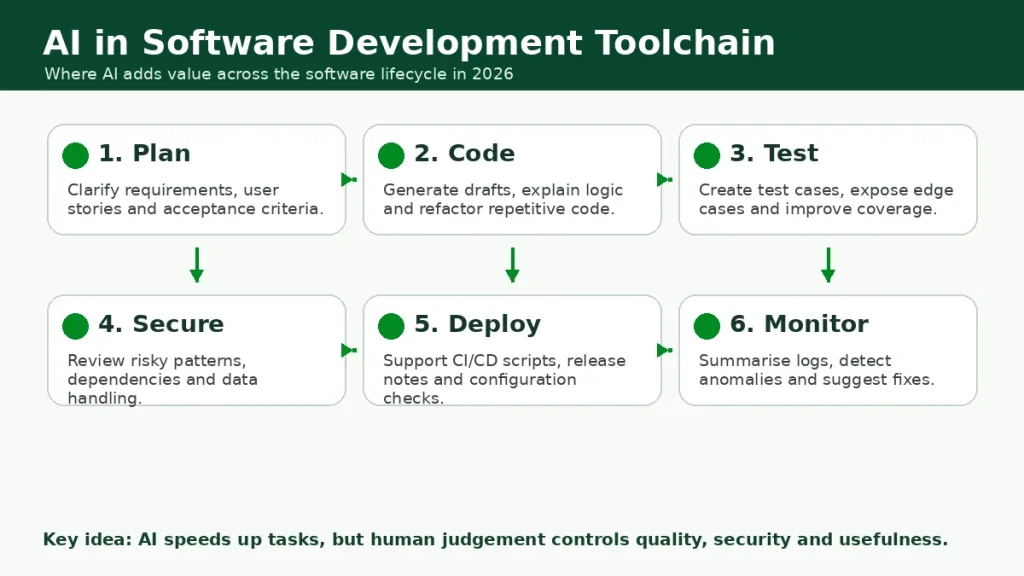
The adoption numbers show how quickly the field has changed. The Stack Overflow Developer Survey found that 84% of respondents were already using or planning to use AI tools in their development process. It also found that 51% of professional developers use AI tools daily.
Google’s DORA research reported that AI adoption among software development professionals had reached 90%, with many professionals spending a median of two hours per day working with AI.
That tells us something important: AI-assisted development is no longer a future trend. It is part of the daily workflow.
But here is the catch. Adoption does not automatically equal value.
A team can use AI every day and still produce poor software. A junior developer can generate code quickly and still fail to understand what it does. A business can roll out AI tools across its engineering team and still increase risk if it lacks governance, testing, and review standards.
The winning teams will not be the ones that simply use the most AI tools. They will be the ones that build the strongest AI-assisted development discipline.
The Main AI Tools Used in Software Development
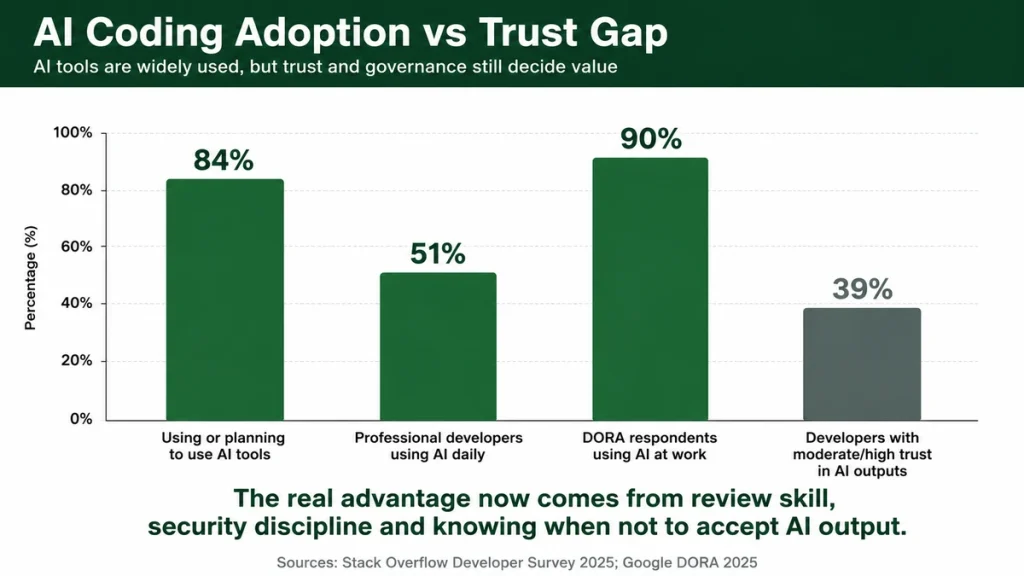
AI tools in software development can be grouped into six broad categories.
1. AI Coding Assistants
AI coding assistants help developers write, complete, explain, and refactor code. Examples include tools such as GitHub Copilot, Cursor, Amazon Q Developer, Gemini Code Assist, JetBrains AI, ChatGPT, and Claude.
These tools are useful for creating first drafts, speeding up repetitive work, explaining syntax, and suggesting patterns. They are especially helpful when developers already understand the logic and need support with execution.
However, they should not be treated as automatic truth machines. AI-generated code must be reviewed like code written by a junior developer: useful, fast, but not always production-ready.
2. AI Testing Tools
Testing is one of the areas where AI can add serious value. AI can help generate test cases, identify edge cases, improve unit test coverage, and explain failed tests.
For example, a developer can ask an AI tool to review a function and suggest possible inputs that may break it. This can reveal cases that the developer did not initially consider.
The benefit is not that AI replaces testing teams. The benefit is that it reduces the friction of starting testing and helps developers think more broadly about quality.
3. AI Debugging Tools
Debugging often takes more time than writing code. AI can help developers understand error messages, trace possible causes, explain stack traces, and suggest fixes.
This is useful when working with unfamiliar frameworks or large codebases. A developer can paste an error message, describe the context, and receive a clearer explanation of what may be going wrong.
The danger is accepting the first answer without investigation. Strong developers use AI debugging suggestions as clues, not final answers.
4. AI Documentation Tools
Documentation is often delayed because teams are busy shipping features. AI can help by summarising functions, drafting README files, explaining APIs, and turning technical notes into clearer documentation.
This matters for businesses because documentation protects institutional knowledge. When only one developer understands a system, the organisation becomes vulnerable. AI-assisted documentation can help teams preserve knowledge and onboard new developers faster.
5. AI Security Tools
AI can assist with secure coding by identifying suspicious patterns, insecure dependencies, poor input handling, and possible data exposure risks.
This is becoming more important as software teams use AI to build faster. Faster development without security review can create more vulnerabilities. Developers need to understand both AI assistance and secure software principles.
Professionals interested in this area may also benefit from exploring Cybersecurity with AI, because AI software development and cybersecurity are becoming increasingly connected.
6. AI Agents
AI agents go beyond basic chat-based tools. They can plan tasks, use tools, make changes across files, and complete multi-step workflows.
This is where software development is heading. GitHub’s Octoverse 2025 highlighted AI, agents, and typed languages as major forces reshaping development. Gartner has also argued that teams should not limit AI in software engineering to coding alone, because stronger productivity gains are likely to come from applying AI across the full software development lifecycle.
The rise of agents means developers will need new skills: orchestration, permissions, monitoring, evaluation, and human approval design.
The Real Benefits of AI in Software Development
The biggest benefit of AI in software development is not simply speed. It is leverage.
AI gives developers leverage over repetitive tasks. It helps them move from blank page to working draft faster. It supports learning, testing, documentation, and debugging. It can reduce the time spent on low-value manual tasks so developers can focus on higher-value thinking.
For businesses, the potential benefits include:
- Faster prototyping
- Shorter development cycles
- Better documentation
- More consistent testing
- Improved developer learning
- Faster onboarding
- Better use of senior developer time
- Stronger experimentation capacity
This matters because software is no longer limited to technology companies. Banks, schools, hospitals, retailers, government departments, logistics companies, and small businesses all rely on software to operate.
When AI makes software development more accessible, more organisations can build internal tools, automate processes, improve customer experiences, and use data more effectively.
But this opportunity only becomes real when AI is used with discipline.
The Biggest Risks of AI in Software Development
AI in software development brings real value, but it also brings real risks. These risks are not reasons to avoid AI. They are reasons to use it properly.
1. Poor Code Quality
AI can generate code that looks correct but contains hidden flaws. It may use outdated libraries, inefficient logic, weak patterns, or code that works only in simple cases.
This is dangerous because AI-generated code often appears confident. A beginner may assume that polished code is reliable. Experienced developers know that software quality depends on testing, context, architecture, and maintainability.
2. Security Vulnerabilities
Security is one of the biggest concerns. AI-generated applications may mishandle authentication, expose sensitive data, use insecure dependencies, or fail to validate inputs properly.
The OWASP Top 10 for Large Language Model Applications highlights risks such as prompt injection, insecure output handling, training data poisoning, model denial of service, and supply chain vulnerabilities.
These risks matter because modern software increasingly connects to AI models, APIs, databases, and third-party services. A weak design decision can expose an entire system.
3. Overreliance on AI
AI tools can make developers faster, but they can also weaken learning if used carelessly.
A learner who copies AI-generated code without understanding it may finish tasks quickly but fail to build real competence. This creates a career problem. Employers do not only need people who can prompt AI. They need people who can understand, test, explain, and improve what AI produces.
The future belongs to AI-assisted developers, not AI-dependent developers.
4. Technical Debt
AI can produce more code faster. That sounds good until a team realises it has created more code than it can maintain.
Technical debt happens when teams choose quick solutions that create long-term problems. AI can accelerate technical debt if developers accept generated code without checking architecture, naming, structure, performance, and maintainability.
In simple terms, AI can help teams move faster in the wrong direction.
5. Shadow AI
Shadow AI happens when employees use AI tools without approval, governance, or security oversight. This may include pasting private code, client information, credentials, or business data into public AI tools.
IBM’s Cost of a Data Breach Report 2025 warns that rushing into AI without security and governance can put data and reputation at risk.
For businesses, the solution is not to ban AI completely. The solution is to create clear policies, approved tools, training, and review processes.
What Businesses Should Do Before Using AI Development Tools
Businesses need an AI software development strategy, not just tool subscriptions.
A strong approach should include:
- Approved AI tools
- Clear data privacy rules
- Secure coding standards
- Human review requirements
- Testing expectations
- Documentation rules
- Usage monitoring
- Developer training
- Governance for AI agents
- Clear accountability for production code
The most important principle is simple: AI can assist, but humans remain responsible.
No business should release code simply because an AI tool produced it. Production software must still go through proper review, testing, security checks, and business validation.
Organisations that want to build AI capability across teams can explore Regenesys Corporate Education or the AI Capability Suite, which focuses on strengthening AI-related capability for modern organisations.
Career Opportunities in AI Software Development
AI is changing software development careers, but it is not removing the need for skilled developers. Instead, it is changing what skilled means.
The World Economic Forum Future of Jobs Report 2025 lists AI and big data among the fastest-growing skills. The US Bureau of Labor Statistics also projects 15% employment growth for software developers, quality assurance analysts, and testers from 2024 to 2034, which is much faster than the average for all occupations.
This points to a practical career insight: software development is not disappearing. It is becoming more AI-enabled.
Possible career paths include:
- AI Software Developer
- Junior Software Developer
- Full Stack Developer
- AI Application Developer
- Machine Learning Developer
- Software Tester or QA Analyst
- Prompt Engineer for technical workflows
- DevOps Engineer with AI skills
- AI Product Developer
- Technical Support Engineer for AI applications
The most attractive candidates will be those who understand both software fundamentals and AI-assisted workflows.
This is why the Artificial Intelligence Software Developer programme is relevant for learners who want to build practical skills for intelligent application development, problem-solving, and future-ready technology careers.
Learners who want a broader introduction to artificial intelligence can also explore the Regenesys School of AI, the AI for Developers pathway, or the online Artificial Intelligence Course from Digital Regenesys.
Skills Needed for AI Software Development
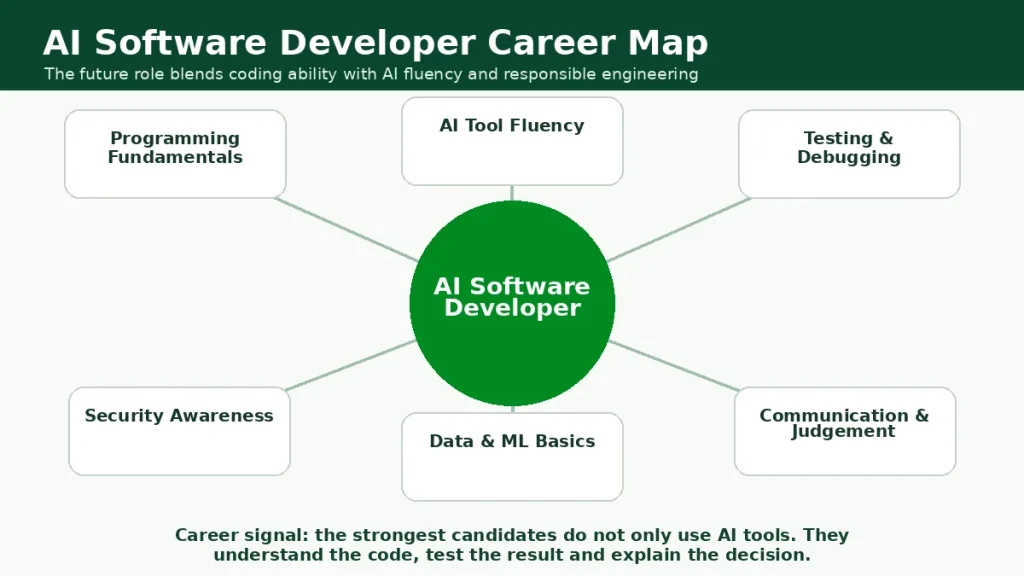
To succeed in AI software development, learners need more than tool familiarity. They need a balanced skill set.
Programming Fundamentals
A developer must understand variables, functions, logic, data structures, algorithms, APIs, databases, and software design principles. AI can assist with code, but it cannot replace foundational understanding.
AI Tool Fluency
Developers must know how to prompt AI tools clearly. Good prompts include context, constraints, desired output, examples, and acceptance criteria.
A weak prompt produces generic output. A strong prompt helps the AI produce more useful work.
Testing and Debugging
AI-generated code must be tested. Developers need to know how to create meaningful test cases, check edge cases, and debug confidently.
Cybersecurity Awareness
As AI-powered applications grow, secure development becomes essential. Developers need to understand privacy, authentication, access control, input validation, and safe API use.
Data and Machine Learning Basics
AI software developers should understand how data is collected, cleaned, processed, and used in models. They do not all need to become researchers, but they do need to understand how AI systems behave.
Communication and Business Thinking
The best developers do not only write code. They understand problems. They ask better questions. They explain trade-offs. They connect software decisions to business outcomes.
This is where human value becomes clearer. AI can generate output. Humans must define purpose.
The Future of AI in Software Development
The next phase of AI in software development will be more agentic, more integrated, and more demanding.
AI tools will move deeper into development environments. Agents will handle larger tasks. Testing and documentation will become more automated. Developers will spend more time reviewing, orchestrating, securing, and improving AI-assisted work.
But this future will not reward laziness.
It will reward developers who understand the full software lifecycle. It will reward businesses that combine AI adoption with governance. It will reward learners who build strong fundamentals and then use AI to extend their capability.
The biggest mistake is thinking AI makes software development easy. It does not. It makes certain tasks faster, while making judgement more important.

Conclusion
AI in software development is changing the tools developers use, the risks businesses must manage, and the careers learners can build.
The opportunity is huge, but it is not automatic. AI can speed up development, improve testing, support documentation, and help teams build smarter applications. It can also create poor code, security gaps, technical debt, and false confidence when used without skill.
That is why the future belongs to developers who can combine technical fundamentals with AI capability. They will know how to prompt, review, test, secure, and improve AI-assisted work. They will not simply ask AI to build software. They will understand how to build better software with AI.
For learners ready to prepare for this future, the Artificial Intelligence Software Developer programme offers a practical route into one of the most important technology careers of the AI era.
FAQs About AI in Software Development
What is AI in software development?
AI in software development is the use of artificial intelligence tools to support coding, testing, debugging, documentation, security review, deployment, and software design.
What are the best AI tools for software development?
Common AI tools for software development include coding assistants, testing tools, debugging tools, documentation tools, security tools, and AI agents. The best tool depends on the task, team, security requirements, and development environment.
Is AI in software development risky?
Yes, it can be risky if used without review. Common risks include poor code quality, security vulnerabilities, technical debt, overreliance on AI, and shadow AI. These risks can be managed through governance, testing, secure coding, and human review.
Will AI replace software developers?
AI is more likely to change software development roles than replace skilled developers entirely. Developers will still be needed to define problems, review code, design systems, test outputs, manage security, and make technical decisions.
Is AI software development a good career?
Yes. AI software development is a strong career direction because businesses increasingly need professionals who can build intelligent applications and use AI tools responsibly. The most valuable developers will combine coding fundamentals with AI fluency.
Where can I study AI software development?
You can explore the Artificial Intelligence Software Developer programme from Regenesys Skills Academy. It is designed to help learners build practical AI software development skills for a fast-changing digital world.