
A few years ago, developers asked whether AI could write code. In 2026, that question already feels outdated. The better question is this: if AI can help write, test, debug, document and even suggest architecture, what does a software developer actually become?
Table of Content
That is where the real transformation is happening. AI is not simply making software development faster. It is changing the shape of the work itself. Developers are moving from manual code production to higher-value thinking: defining problems, guiding AI tools, reviewing outputs, designing systems, improving security and making sure software works for real people.
For businesses, this shift matters because software is no longer only an IT function. It is how companies automate work, serve customers, analyse data and compete. For professionals, it means the future belongs to those who can combine coding ability with AI fluency.
That is why structured learning pathways such as the Artificial Intelligence Software Developer programme are becoming increasingly important for anyone who wants to build intelligent, practical and career-relevant software solutions.

What Does AI in Software Development Mean?
AI in software development refers to the use of artificial intelligence tools, models and systems to support or automate parts of the software development lifecycle.
This includes:
- Writing code suggestions
- Generating test cases
- Explaining unfamiliar code
- Debugging errors
- Refactoring old systems
- Creating documentation
- Detecting security risks
- Building AI-powered applications
- Supporting deployment and monitoring
In simple terms, AI acts like a powerful assistant across the development process. It can help developers move faster, but it still needs human direction. AI may generate code, but people decide whether that code is correct, secure, scalable and useful.
This distinction is important. The future of software development is not “AI versus developers”. It is “developers who know how to work with AI” versus “developers who ignore it”.
Why AI Is Transforming Software Development in 2026
The biggest reason AI is transforming software development in 2026 is adoption. AI tools are no longer experimental add-ons used by a few curious developers. They are becoming part of everyday engineering workflows.
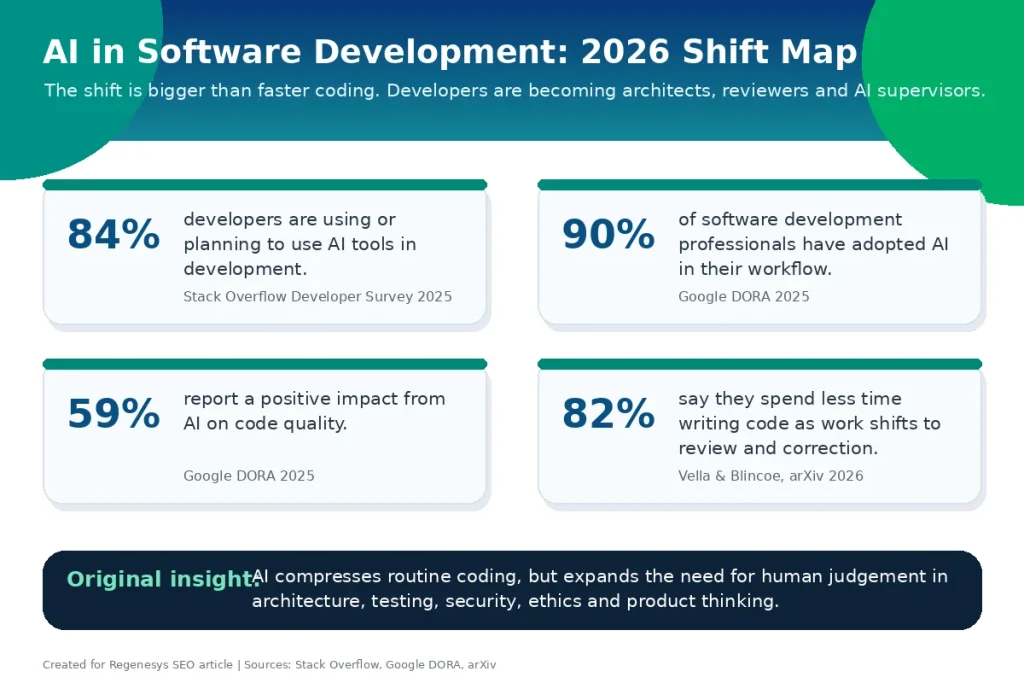
The Stack Overflow Developer Survey found that 84% of respondents were already using or planning to use AI tools in their development process, with 51% of professional developers using them daily. Google’s DORA research also reported that AI adoption among software development professionals had reached 90%.
That tells us something powerful: AI has moved from novelty to normal. But the transformation is not only about tool adoption. It is about workflow redesign. Developers are no longer using AI only for autocomplete. They are using it to understand systems, generate boilerplate, create first drafts of features, write tests and explore solutions faster.
This has created a new development rhythm:
- Human defines the problem.
- AI produces a possible solution.
- Human reviews, improves and validates it.
- AI helps test and document it.
- Human decides whether it is ready for production.
This is the new loop of AI-assisted development.
AI in Software Development 2026 Shift Map
AI Is Changing the Developer’s Role
The traditional image of a developer is someone sitting alone, writing code line by line. That image no longer captures the full reality. In 2026, developers are becoming AI supervisors, system designers and quality guardians.
A 2026 longitudinal study on AI coding assistants introduced the idea of “supervisory engineering work”, where developers spend more time directing, evaluating and correcting AI-generated output. This is one of the most important shifts in software engineering today.
Instead of asking, “Can this person write every line of code manually?”, employers increasingly ask:
- Can this person understand the problem?
- Can they guide AI tools properly?
- Can they evaluate the output?
- Can they spot weak logic?
- Can they protect the system from poor code, security flaws and technical debt?
That means the developer’s value is moving upward. The most valuable developers are not just code typists. They are problem-solvers who understand software architecture, data, AI models, users and business goals.
This is why becoming an artificial intelligence software developer is no longer a niche career path. It is becoming part of the broader future of software work.
AI Is Speeding Up Coding, But Not Removing Thinking
AI can write code quickly. That does not mean it writes the right code automatically.
This is where many businesses misunderstand AI in software development. They assume faster code generation automatically means better software. In reality, speed only creates value when it is paired with quality.
AI is excellent at repetitive coding tasks, boilerplate, simple functions, explanations and first drafts. It can help developers avoid blank-page syndrome and move quickly from idea to prototype.
However, AI still struggles when the task depends on deep business context, legacy system knowledge, complex architecture, unusual edge cases or strict security requirements.
That is why the human role remains essential.
A developer must still ask:
- Does this solution solve the right problem?
- Is the code secure?
- Can it scale?
- Will it break something else?
- Does it follow the organisation’s standards?
- Can another developer maintain it later?
AI can accelerate execution, but judgement remains human.
AI Is Improving Testing and Debugging
One of the most valuable uses of AI in software development is testing. Testing is often treated as a final step, but in modern software teams it is central to quality. AI can help generate unit tests, identify missing test cases, explain errors and suggest possible fixes. This is especially useful when developers are working under pressure or maintaining large codebases.
For example, a developer can ask an AI tool to inspect a function and suggest edge cases. The tool may identify inputs that the developer had not considered, such as empty values, unusual formats or boundary conditions. This does not replace proper quality assurance. It strengthens it.
The real advantage is that AI can make testing easier to start. Many developers know they should write more tests, but time pressure often gets in the way. AI reduces that friction by producing a first draft.
The developer’s job is then to improve the tests, remove weak assumptions and make sure they match real user behaviour.

AI Is Making Documentation Less Painful
Documentation has always been one of the most neglected parts of software development. Developers know it matters, but it is often delayed because teams prioritise shipping features. AI is changing this by making documentation faster and easier to produce.
AI can summarise code, explain APIs, draft README files, describe functions and turn technical notes into clearer instructions. This helps teams onboard new developers faster and reduces dependency on one person who “knows how everything works”.
For businesses, this matters because poor documentation creates hidden risk. When knowledge sits inside one developer’s head, the organisation becomes vulnerable. If that developer leaves, the team loses context. AI-assisted documentation helps turn individual knowledge into shared organisational knowledge.
AI Is Transforming Legacy System Modernisation
Many organisations still rely on old systems that are difficult to maintain. These systems may be written in older languages, poorly documented or connected to critical business processes. AI can support legacy modernisation by explaining old code, identifying dependencies, suggesting refactoring options and helping developers translate logic into more modern frameworks.
This does not mean companies can hand an old system to AI and expect a perfect rebuild. Legacy systems often contain years of business rules that are not documented anywhere. AI may understand the code structure, but it may not understand why the code exists. That is why AI modernisation works best when experienced developers guide the process. The AI can help with analysis and first drafts, while humans protect the business logic.
In 2026, this will be one of the biggest opportunities for businesses. Companies that modernise intelligently can reduce technical debt, improve security and make future digital transformation easier.
AI Agents Are Changing How Software Gets Built
The next big shift is the rise of AI agents. Traditional AI coding assistants respond to prompts. AI agents go further. They can plan steps, use tools, make changes across files and complete more complex tasks with less constant instruction.
Gartner has predicted that up to 40% of enterprise applications will include task-specific AI agents by the end of 2026, up from less than 5% in 2025. This matters for software development because developers will increasingly build systems that include AI agents, connect to AI agents or are maintained with the help of AI agents.
This creates new technical responsibilities.
Developers will need to understand:
- How agents make decisions
- How to control permissions
- How to monitor outputs
- How to prevent unsafe actions
- How to design human approval steps
- How to audit agent behaviour
This is where AI software development becomes more than coding. It becomes governance, design and accountability.
The Skills Developers Need in 2026
AI is changing the skills required to succeed in software development. Coding still matters, but it is no longer enough on its own.
The strongest developers in 2026 need a wider skill set.
1. Programming Fundamentals
AI can suggest code, but developers still need to understand logic, data structures, algorithms and clean coding principles. Without fundamentals, they cannot judge whether AI output is correct.
2. Prompting and AI Tool Use
Developers must know how to give clear instructions to AI systems. A vague prompt often produces vague code. A strong prompt includes context, constraints, expected output and examples.
3. Software Architecture
As AI handles more routine tasks, architecture becomes more valuable. Developers must understand how systems connect, scale and remain maintainable.
4. Testing and Quality Assurance
AI-generated code must be tested carefully. Developers who can design strong test cases will be more valuable than those who simply accept AI outputs.
5. Cybersecurity Awareness
AI can introduce insecure code if it is not reviewed properly. Developers need to understand secure coding, data privacy and access control.
6. Data and Machine Learning Basics
As more software becomes AI-powered, developers need to understand data, models, APIs and the basics of machine learning.
7. Communication
AI-assisted development requires clearer communication with teams, stakeholders and AI tools. Developers must translate business problems into technical solutions.
These are the types of practical capabilities learners can begin developing through the Occupational Certificate: Artificial Intelligence Software Developer, which focuses on hands-on AI software development for real-world problem-solving.
What This Means for Businesses
For businesses, AI in software development is not just a technology trend. It is a productivity, competitiveness and talent issue.
Companies that adopt AI well can build faster, test better and reduce repetitive work. But companies that adopt AI carelessly may create new risks, including poor code quality, security weaknesses and uncontrolled technical debt.
The difference is not the tool. The difference is the system around the tool.
Businesses need clear rules for AI use in development. They need developers who understand both software engineering and AI. They need review processes, testing standards, security checks and ethical guidelines.
This is why AI upskilling is becoming important for technical teams and leadership teams. Organisations that want to build AI-ready teams can also explore Regenesys Corporate Education, which offers corporate learning solutions across leadership, management and digital skills areas.
What This Means for Aspiring Developers
For aspiring developers, this is not a reason to panic. It is a reason to prepare.
AI will reduce the value of only knowing how to write basic code. But it will increase the value of people who can build useful systems with AI.
A beginner who learns software development in 2026 should not avoid AI tools. They should learn with them responsibly.
That means understanding what the AI is doing, not blindly copying answers. It means learning the logic behind the code. It means practising debugging, testing and explaining solutions.
The future developer is not someone who competes against AI. The future developer is someone who can use AI to build better software.
Learners who want broader exposure to artificial intelligence can also explore the Regenesys School of AI and its AI for Developers pathway, while those looking for flexible online learning can review the Digital Regenesys Artificial Intelligence Course.
The Biggest Misconception About AI in Software Development
The biggest misconception is that AI makes software development easy, not really. AI makes some parts faster. It also makes some parts more complex. When code is easy to generate, the challenge shifts to knowing what should be generated. When tests are easy to draft, the challenge shifts to knowing whether they are meaningful. When documentation is easy to create, the challenge shifts to whether it is accurate.
This is the pattern that many people miss: AI removes some friction, but it raises the standard of judgement. In the past, junior developers often proved themselves by producing code. In the AI era, they will need to prove themselves by understanding code, improving code and explaining decisions. That is a higher bar, not a lower one.
How AI Software Development Will Evolve Beyond 2026
AI-assisted software development will continue moving in three directions.
First, tools will become more agentic. They will handle larger tasks, work across multiple files and support longer development workflows.
Second, software teams will become smaller but more capable. A small team with strong AI tools may achieve what previously required a larger group.
Third, the boundary between developer, analyst, tester and product thinker will become less rigid. Developers will need to understand more of the full product lifecycle.
This does not mean every developer must become a machine learning researcher. But it does mean every developer should understand how AI changes software design, delivery and maintenance. The best career move is to build a strong technical foundation, then layer AI capability on top of it.

Conclusion
AI is transforming software development in 2026 by changing not only how code is written, but how software is planned, tested, reviewed, secured and maintained. The developer of the future will not be measured only by typing speed or syntax knowledge. They will be measured by judgement, creativity, technical understanding and the ability to work intelligently with AI systems.
For businesses, this means AI-ready development teams will become a competitive advantage. For aspiring developers, it means the best time to build AI software development skills is now. The future of software development is not code without humans. It is better software built by humans who know how to use AI well.
To begin building these skills, explore the Artificial Intelligence Software Developer programme and prepare for a career shaped by intelligent systems, practical innovation and future-ready software development.
FAQs About AI in Software Development
What is AI in software development?
AI in software development is the use of artificial intelligence tools to support coding, testing, debugging, documentation, deployment and software design. It helps developers work faster while still requiring human review and judgement.
Will AI replace software developers?
AI is unlikely to replace skilled software developers completely. It is more likely to change their roles. Developers will spend less time on repetitive coding and more time on problem-solving, architecture, testing, security and AI supervision.
How is AI changing coding in 2026?
AI is helping developers generate code, understand errors, write tests, review logic and document systems. It is also introducing AI agents that can complete more complex tasks across development workflows.
What skills are needed for AI software development?
Important skills include programming, software architecture, testing, cybersecurity awareness, AI tool use, data understanding, machine learning basics, problem-solving and communication.
Is AI software development a good career path?
Yes. As more businesses build AI-powered systems, demand is growing for professionals who understand both software development and artificial intelligence. Structured training can help learners build practical, job-relevant skills.
Where can I study AI software development?
You can explore the Artificial Intelligence Software Developer programme from Regenesys Skills Academy. It is designed to help learners build practical AI software development skills for real-world applications.