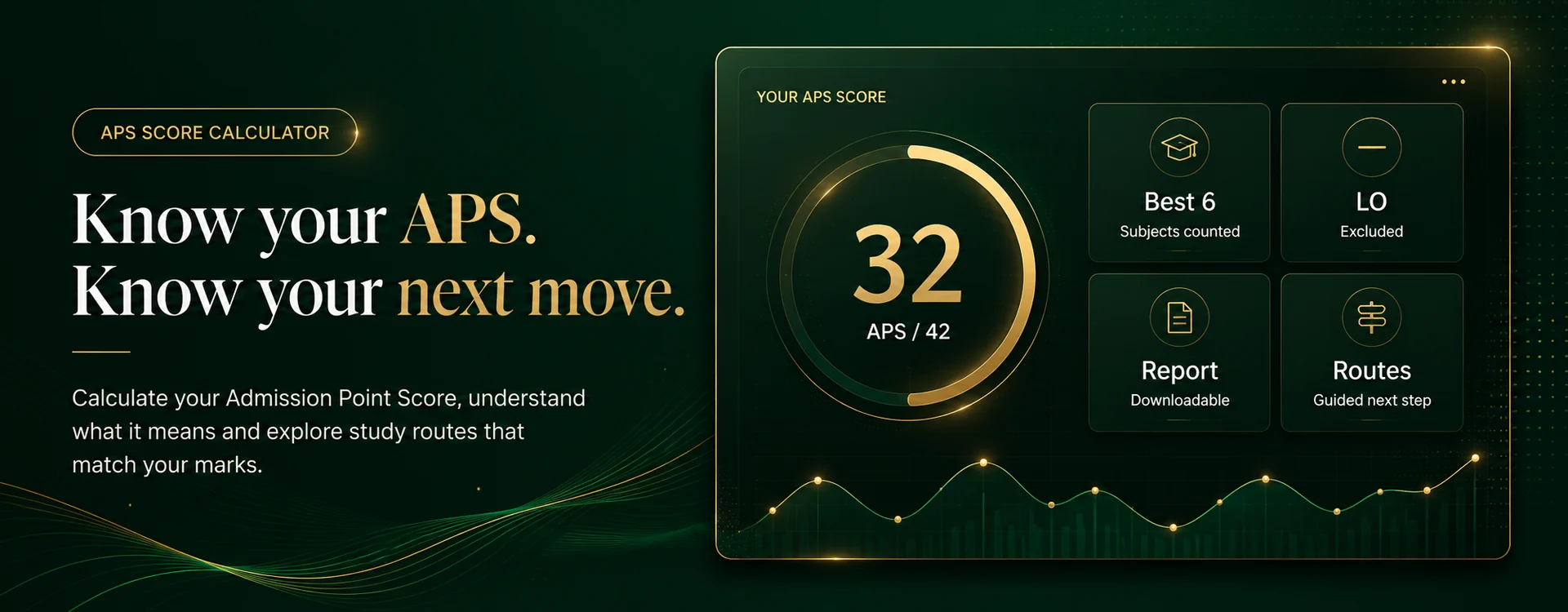
What Is an APS Score?
APS stands for Admission Point Score. It is a points-based score used by many South African higher education institutions to help assess whether applicants meet the academic entry requirements for certain programmes.
Your APS is calculated by converting your subject percentages into points and adding them together. A higher APS may open more study options, but your APS is only one part of the admissions process. Your pass type, subject choices, English mark, Mathematics mark and specific programme requirements also matter.
For example, some degree routes require a Bachelor pass, while certain programmes may also require Mathematics, English or specific subject readiness. The BSc Computer Science page lists a Bachelor pass or relevant NQF Level 5 route as part of its admission requirements, while the BEd page also notes that subject and phase requirements should be checked with an advisor.
How to Calculate Your APS Score
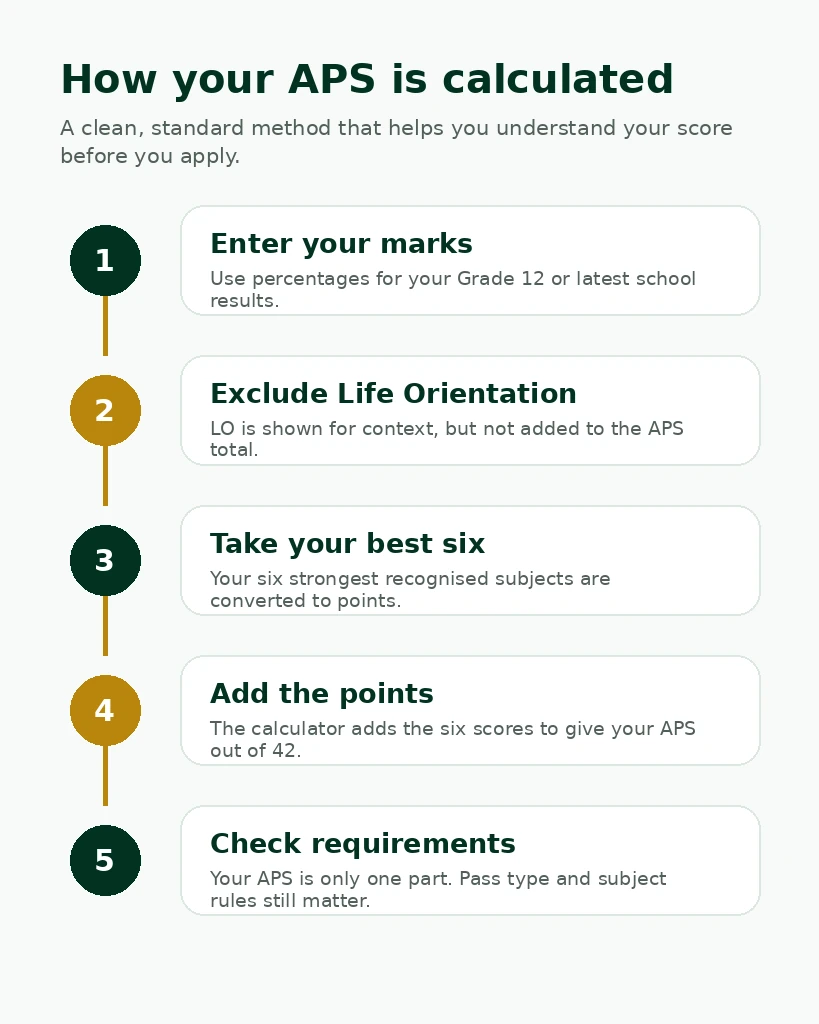
Most standard APS calculations use your best six recognised 20-credit subjects and exclude Life Orientation.
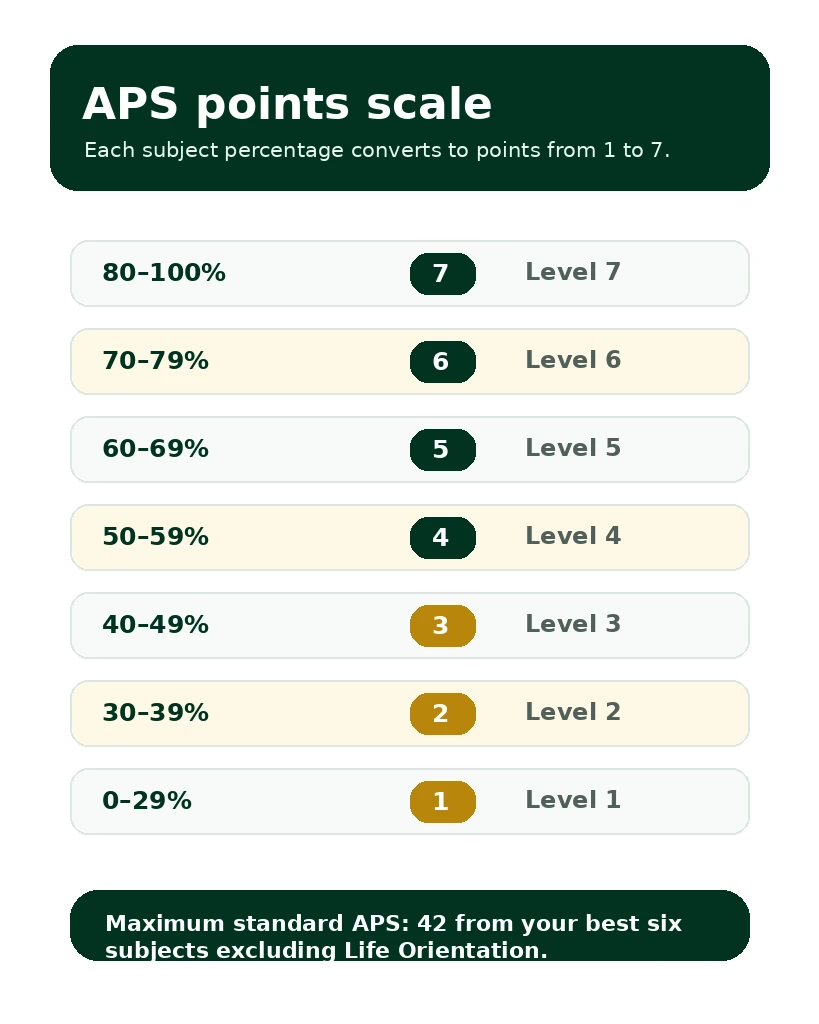
Each subject percentage is converted into points:
- 80–100% = 7 points
- 70–79% = 6 points
- 60–69% = 5 points
- 50–59% = 4 points
- 40–49% = 3 points
- 30–39% = 2 points
- 0–29% = 1 point
The highest standard APS is usually 42, calculated from six subjects worth a maximum of 7 points each.
How This APS Calculator Works
This calculator is designed to give you more than a number.
It helps you:
- Download your APS Score Report
- Enter your subjects and marks
- Exclude Life Orientation from the APS total
- Calculate your score out of 42
- See which six subjects were counted
- Check your pass type
- Review English, Mathematics and Science readiness
- Explore possible study routes
Does Life Orientation Count for APS?
In many standard APS calculations, Life Orientation is not included in the final APS total. This calculator asks you to enter Life Orientation for context, but it excludes it from the APS calculation. Your final APS is based on your best six recognised subjects.
This gives you a clearer view of your score while still helping you keep your full subject profile in one place.
What Can I Study With My APS Score?
Your APS score can help you identify possible study routes, but it should not be used in isolation.
A student with a strong APS may still need to meet subject-specific requirements. A student with a lower APS may still have access to higher certificate, skills-based or alternative entry routes.
That is why this calculator gives guidance in three ways:
- Your APS score
- Your pass type
- Your subject readiness
For example, the LLB requires a Bachelor pass or equivalent, with English 1st at 50% or English 2nd at 60%. The Bachelor of Accounting Science requires a Bachelor pass or relevant NQF Level 5 route, plus Mathematics and English competence.
APS Score and Study Route Guide
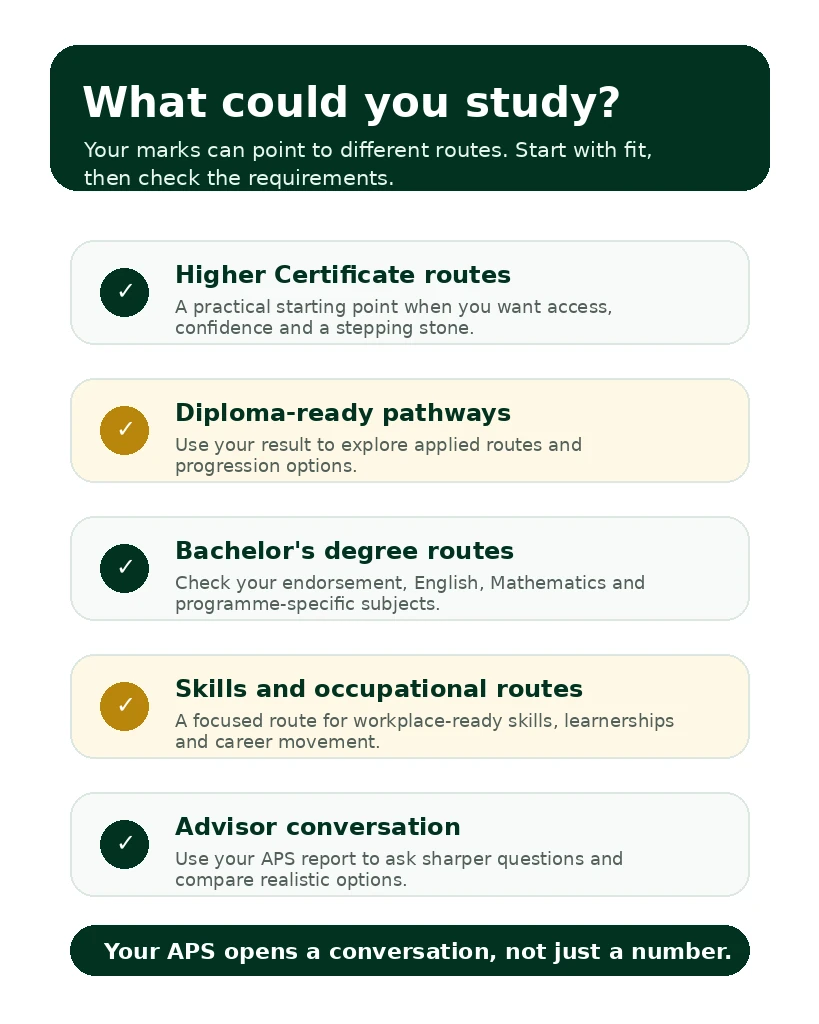
Higher Certificate routes
If your marks do not yet meet Bachelor degree entry requirements, a higher certificate can be a smart starting point. It can help you build confidence, earn credits and work towards further study.
Diploma-ready pathways
A diploma pass may open applied study routes. You should still check the exact programme requirements before making a decision.
Bachelor’s degree routes
A Bachelor pass can open access to degree-level study, but you still need to check subject requirements. Some degrees may require Mathematics, English or other specific academic readiness.
Skills and occupational routes
Your APS is not the only way forward. Skills programmes, occupational certificates and workplace-focused learning can help you build practical capability and move towards a career goal.
Advisor conversation
Your APS report gives you a stronger starting point. Instead of asking, “What can I study?”, you can ask, “Given my APS, pass type, subjects and interests, which route makes the most sense?”
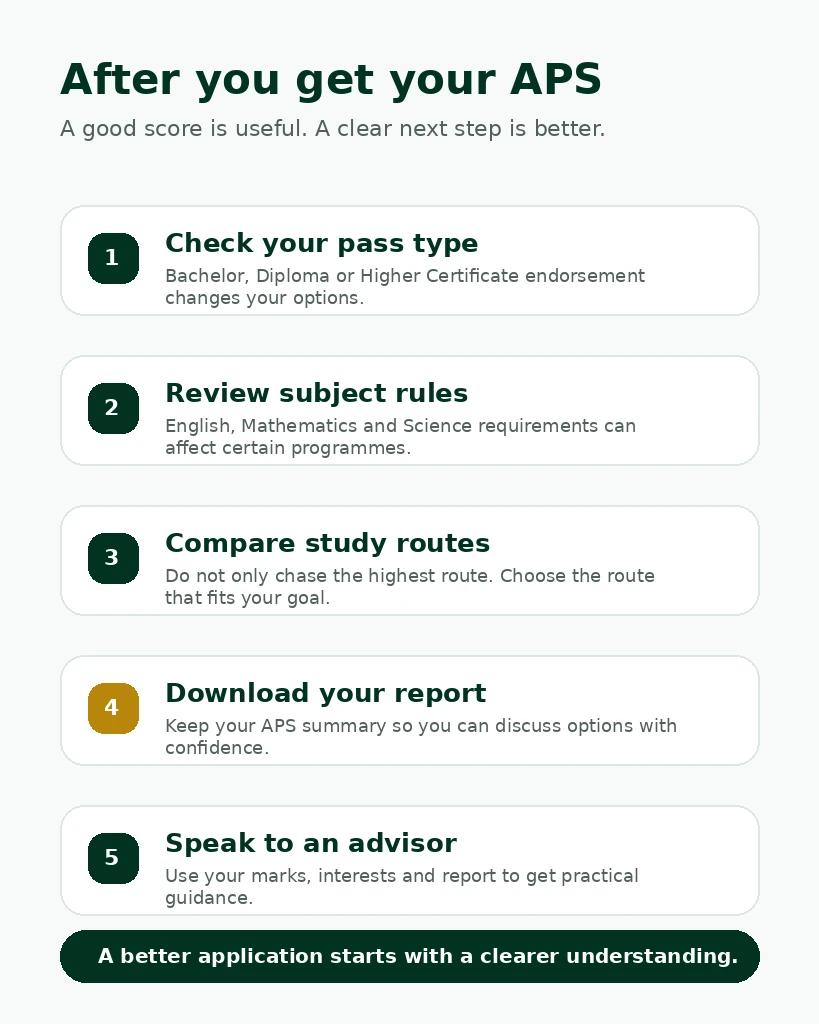
What to Do After Calculating Your APS
Once you have your APS result, do not stop at the number.
Use your result to ask better questions:
- Do I have a Bachelor, Diploma or Higher Certificate pass?
- Which subjects were counted in my APS?
- Does my English mark meet the requirement?
- Did I take Mathematics or Mathematical Literacy?
- Do my marks fit the programme I am interested in?
- Is there a better stepping-stone route?
- Should I speak to an advisor before applying?
Download Your APS Score Report
After calculating your score, you can download your APS Score Report.
Your report includes:
- Your APS score out of 42
- Your subjects counted
- Your points per subject
- Your pass type guidance
- Subject checks
- Study routes worth exploring
- Practical next steps
Keep this report and use it when comparing programmes or speaking to an advisor.
Explore Study Options That Match Your Marks
Your APS score is not just a number. It is a starting point. Once you know your score, you can explore study routes that fit your marks, interests and goals.
Career Aptitude Test FAQs
What is an APS calculator?
An APS calculator is a tool that helps you calculate your Admission Point Score by converting your school subject marks into points.
How is APS calculated?
APS is calculated by converting each subject percentage into a point score and adding the selected subjects together. Many standard APS methods use the best six subjects and exclude Life Orientation.
Does Life Orientation count for APS?
In many standard APS calculations, Life Orientation is excluded. This calculator excludes Life Orientation from your APS total.
What is the highest APS score?
Using the standard best-six method, the highest APS score is 42.
Can I use Grade 11 marks?
Yes. You can use Grade 11 marks for planning, but final admission decisions normally depend on official final results and programme requirements.
Does a high APS guarantee admission?
No. A high APS does not guarantee admission. Final admission depends on your official results, pass type, subject requirements, available space and admissions review.
What if my APS is low?
A lower APS does not mean you have no options. You may still be able to explore higher certificate routes, occupational qualifications, skills programmes or alternative study pathways.
Why do subject requirements matter?
Some programmes need specific subject readiness. For example, law may require a certain English mark, while accounting, finance or technology programmes may require Mathematics or strong numeracy.
Can this calculator tell me exactly what I qualify for?
It gives guidance based on your APS, pass type and subject information. Final confirmation should always be done through the official admissions process.
Start With Your Score. Then Find Your Direction.
Your APS score can help you understand where you stand. But the real value comes from knowing what to do next.