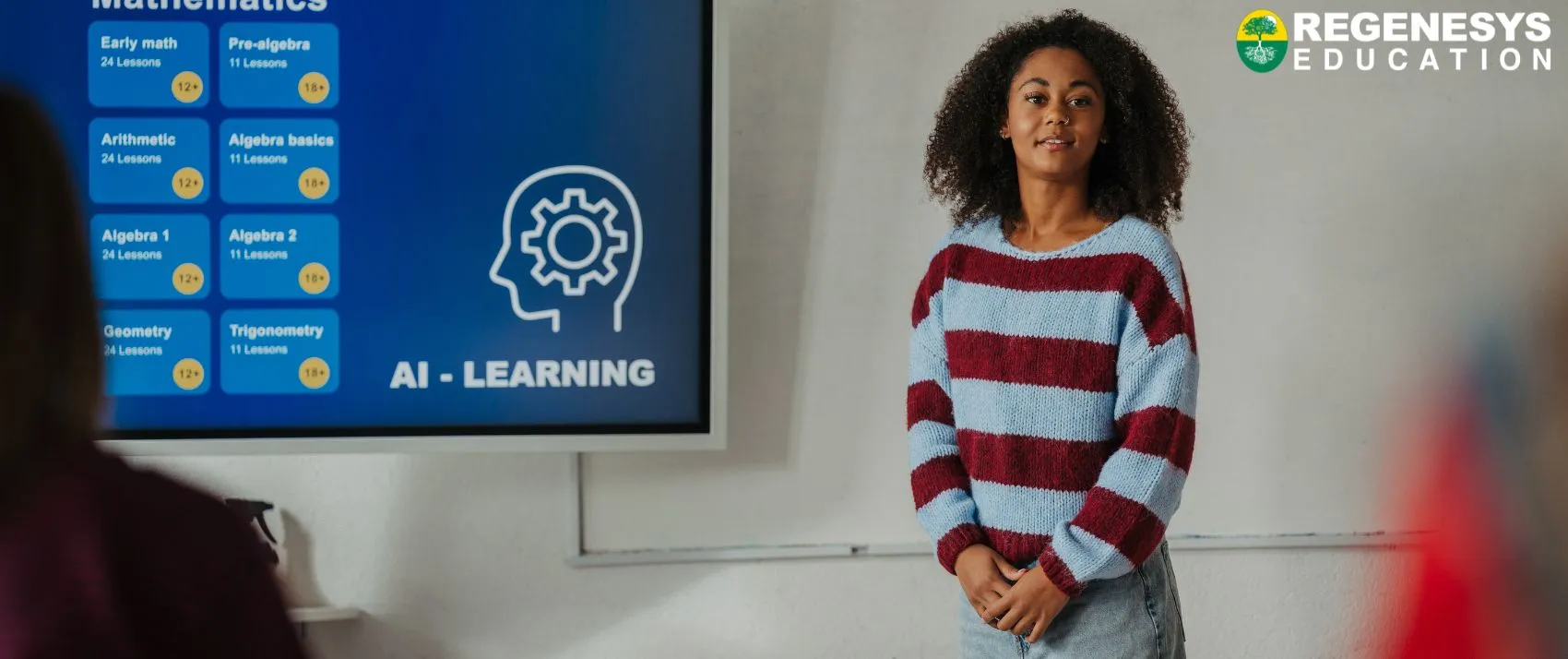

AI in Education is no longer a futuristic talking point. It is already changing how students learn, how teachers prepare, how institutions assess performance, and how leaders think about the skills the modern economy now demands. What used to feel experimental now sits at the centre of serious conversations about quality, access, employability, ethics, and the future of learning itself. According to UNESCO, AI has the potential to help address major challenges in education, while the OECD Digital Education Outlook 2026 makes it clear that generative AI is already reshaping education far beyond the classroom.
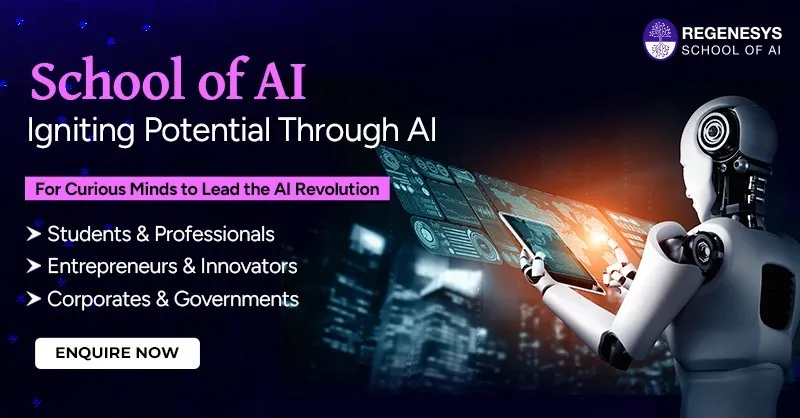
That matters even more in a country like South Africa, where the education conversation cannot only be about technology for technology’s sake. It has to be about relevance. It has to be about access. It has to be about preparing students, professionals, and institutions for a world in which AI will influence almost every sector, from banking and healthcare to law, public management, media, and entrepreneurship. This is why discussions around AI in Education are becoming more urgent, and why initiatives such as the Regenesys School of AI and the upcoming Regenesys AI Summit matter right now.
AI in Education Has Already Moved Beyond Experimentation
One of the biggest mistakes institutions still make is treating AI like a trend that can be watched from a distance. The evidence says otherwise. The OECD reports that 37% of lower secondary teachers used AI for their job in 2024, 57% said it helps them write or improve lesson plans, and 72% believe it can harm academic integrity by allowing students to present AI-generated work as their own. In other words, the shift is already here. The real question is no longer whether AI belongs in education, but whether institutions are leading its use or reacting to it too late.
UNESCO has also highlighted just how widespread this shift has become. In 2025, it noted that over two-thirds of secondary-school students in high-income countries regularly use AI for different tasks. That should be a wake-up call for institutions everywhere. Students are not waiting for policy committees to catch up. They are already using these tools to brainstorm, research, draft, solve, summarise, and study. If institutions do not build thoughtful frameworks around that reality, learners will still use AI, just without proper guidance, ethical grounding, or critical judgement.
Why AI in Education Matters So Much Now
Education has always been shaped by the economy it serves. The difference now is speed. The World Economic Forum’s Future of Jobs Report 2025 says employers expect 39% of key skills in the labour market to change by 2030. That is not a minor adjustment. That is a structural shift. If the world of work is evolving that quickly, then education systems that move slowly are not simply behind. They are actively leaving students underprepared.
The World Bank’s Digital Progress and Trends Report 2025 takes this even further by arguing that countries need strong AI foundations built on connectivity, compute, context, and competency. That last word matters. Competency means skills. It means the ability to use, question, manage, and apply AI meaningfully. So when we talk about AI in Education, we are not only talking about smart tools in a classroom. We are talking about the long-term competitiveness of countries, institutions, organisations, and graduates.
For South Africa and the broader continent, this raises an even deeper issue. Africa cannot afford to be a passive consumer of AI built elsewhere, trained elsewhere, governed elsewhere, and monetised elsewhere. Education is where that dependence is either reinforced or challenged. If schools, universities, and professional institutions can develop people who understand AI strategically, ethically, and practically, then the continent has a real chance to shape its own future instead of renting it from others. That is what makes AI in Education more than an academic topic. It is a development issue, a leadership issue, and a sovereignty issue.
What Good AI in Education Actually Looks Like
The strongest AI in Education models are not built around replacing teachers. They are built around strengthening learning. Used well, AI can support personalised learning pathways, faster feedback, adaptive practice, multilingual support, administrative relief for educators, and better access to knowledge. It can help teachers spend less time on repetitive tasks and more time on teaching, mentoring, and human connection. It can also help institutions identify learning gaps earlier and support students more proactively. UNESCO explicitly recognises AI’s potential to innovate teaching and learning and accelerate progress towards quality education, while the OECD notes that AI can support learning when guided by clear teaching principles.
But the keyword there is guided. The OECD warns that performing better on a task with general-purpose AI does not automatically mean actual learning has taken place. In some cases, the advantage learners gain while using AI disappears when they no longer have access to it during assessments. That is a critical distinction. Institutions that chase efficiency without pedagogy risk producing polished outputs without deeper understanding. The real value of AI in Education comes when technology is paired with sound instructional design, deliberate assessment methods, and strong human judgement.
The Risks Are Real, and Ignoring Them Is Not a Strategy
Every serious discussion about AI in Education has to include risk. There are concerns around privacy, bias, academic integrity, overreliance, misinformation, unequal access, and the possibility that poor institutions fall even further behind. UNESCO has been especially clear on this point. It notes that AI offers promise, but only if it is deployed safely and ethically. It also reminds the world that basic access remains uneven, with one in four primary schools still lacking electricity and only half of lower secondary schools connected to the web. That means any AI strategy that ignores infrastructure and equity will deepen divides instead of solving them.
The governance gap is just as serious. In 2023, UNESCO reported that fewer than 10% of more than 450 surveyed schools and universities had formal guidance on generative AI. By 2025, however, a new UNESCO survey found that nearly two-thirds of higher education institutions in its network either already had AI guidance or were developing it. That progression tells an important story. Institutions are waking up, but many are still early in the journey. The ones that move fastest, and most thoughtfully, will likely shape the standard for everyone else.
The Future of AI in Education Is Not Just Technical. It Is Human
The institutions that will stand out in this era will not be the ones that merely hand students AI tools. They will be the ones that teach students how to think in an AI-shaped world. That includes critical thinking, ethical reasoning, creativity, discernment, problem-solving, data literacy, and the ability to work with intelligent systems without becoming dependent on them. UNESCO noted that in 2022 only 15 countries had included AI learning objectives in their national curricula, and only 7 had developed AI frameworks or programmes for teachers. That shows how early the world still is in creating truly mature AI education systems.
This is why the future of AI in Education belongs to institutions that combine technical fluency with leadership development. Learners do not just need to know how to prompt a model. They need to know when to trust it, when to challenge it, how to verify it, how to apply it in context, and how to use it responsibly in environments where real people are affected by real decisions. That is especially true in sectors like healthcare, finance, education, law, and public administration, where the cost of bad judgement can be high.
Why Regenesys Is Part of This Conversation
This is where the Regenesys School of AI becomes especially relevant. Regenesys positions the School of AI as a human-centric, practical, guided, and responsible platform for AI learning, application, governance, and innovation. Its offering spans AI skilling and education, workflow and integration, consulting, entrepreneurship, government initiatives, and digital learning. The School of AI site also states that it offers 100+ courses and serves 10,000+ learners and alumni, 1,000+ corporate clients, 40+ industries, and 7 countries and expanding. That is the kind of ecosystem approach AI education now needs, because the future of AI will not be built by theory alone. It will be built by institutions that connect learning to real-world execution.
What makes this especially timely is that Regenesys is not approaching AI as an isolated technology topic. It is framing it within leadership, governance, applied learning, and institutional readiness. That matters because many organisations do not fail with AI because the tools are weak. They fail because the people, structures, skills, and decision-making frameworks around those tools are weak. A credible AI education platform has to prepare learners for both adoption and judgement. That broader positioning is one of the reasons the Regenesys School of AI deserves attention in the current education landscape.
Why the Upcoming Regenesys AI Summit Matters
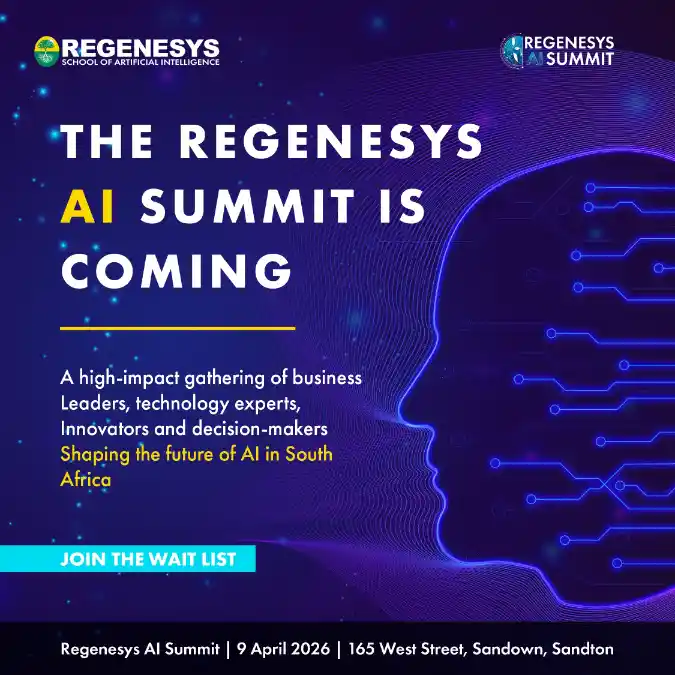
The upcoming Regenesys AI Summit is another sign that the AI in Education conversation is moving into a more practical phase. According to the official summit site, the event will take place on Thursday, 9 April 2026 at the Regenesys Campus, 165 West Street, Sandton, with the AI Summit running from 09h45 to 16h50 and the School of AI Launch from 17h30 to 20h00. The summit is themed “The Future of South Africa in the Age of AI” and is designed to bring together leaders across business, government, technology, and education.
The official programme positions the day around keynote moments, expert-led panel discussions, practical masterclasses, sector-focused insights, exhibitor showcases, demos, networking, the launch of the Regenesys School of AI, and an evening awards celebration. The speaker lineup includes leaders from Regenesys, Microsoft, Amazon Web Services, Standard Bank Group, Aspen Pharmacare, MTN, Life Healthcare, Nokia, Siemens Healthineers, BCX, and NTT DATA Middle East and Africa. That breadth matters because AI in Education cannot be separated from the industries students will eventually serve. The strongest learning conversations are the ones connected to what the real economy is already doing.
Final Thoughts
AI in Education is not about replacing the classroom with machines. It is about rethinking how learning prepares people for a more intelligent, more complex, and more demanding world. The institutions that get this right will not simply produce graduates with technical buzzwords on their CVs. They will produce people who can use AI with confidence, think with depth, act with ethics, and lead with relevance.
That is why this moment matters. The world is moving. Students are already adapting. Employers are already changing. The only question left is whether institutions will lead the transition or chase it from behind. For those who want to take that future seriously, exploring the Regenesys School of AI and paying attention to the Regenesys AI Summit is a very good place to start.
FAQs
What is AI in Education?
AI in Education refers to the use of artificial intelligence tools and systems to support teaching, learning, assessment, administration, and student support. This can include adaptive learning, intelligent tutoring, lesson planning support, analytics, accessibility tools, and AI literacy development.
Can AI replace teachers?
No credible education strategy should treat AI as a replacement for teachers. Evidence highlighted by the OECD suggests AI can support learning when used with pedagogical intent, but stronger task performance does not automatically lead to deeper learning. Human guidance remains essential.
What are the biggest risks of AI in Education?
The biggest risks include bias, privacy concerns, hallucinated information, academic integrity issues, overreliance, and unequal access. UNESCO has repeatedly stressed that AI in education must be guided by ethics, inclusion, and clear policy frameworks.
Why is AI in Education important for South Africa?
It matters because the future labour market is changing fast, and institutions need to prepare students for jobs, industries, and leadership roles shaped by AI. The World Economic Forum and World Bank both point to the growing importance of digital and AI-related capability in future economies.
Where can I learn more about AI education and AI leadership?
You can explore the Regenesys School of AI for programmes and thought leadership, and you can also follow the Regenesys AI Summit for current conversations on AI, leadership, innovation, and education in South Africa.